Trees
How to Grow and Care for Carrotwood Tree
Carrotwood is a Florida noxious weed and illegal to plant there. Here is how to identify it, why it spreads, and what to do if one is on your lot.
The Garden Magic Hub
- Zone
- 10–11
- Light
- Full sun
- Water
- Low
- Level
- Beginner
On this page
Carrotwood was sold across Florida as a tidy, salt-tolerant street tree. It is a good-looking tree and it does the job it was sold for, which is exactly why there is now a problem.
This article is not about how to grow it. In Florida you may not, and the reason is worth understanding wherever you garden.
It is illegal to plant in Florida
Two separate designations apply, and the second one has teeth.
Cupaniopsis anacardioides has been listed as a Florida Category I invasive since 1995 — the category for species that are altering native plant communities, not merely spreading.
Since 1999 it has also been on the Florida Noxious Weed List (Rule 5B-57.007, Florida Administrative Code). That listing makes it unlawful to introduce, possess, move or release the plant in the state without a permit, and it ends commercial sale. You will not find carrotwood at a Florida nursery, and planting one is not a judgement call about garden taste.
UF/IFAS states the position without qualification: carrotwood “is considered an invasive, noxious weed in Florida and should not be planted.”
An existing tree already in your yard is a different matter from planting a new one. Enforcement is aimed at the trade and at movement of the plant, not at homeowners who inherited one. But see below on what that tree is doing.
Why this tree in particular
Plenty of ornamentals escape cultivation. Carrotwood got into places that matter.
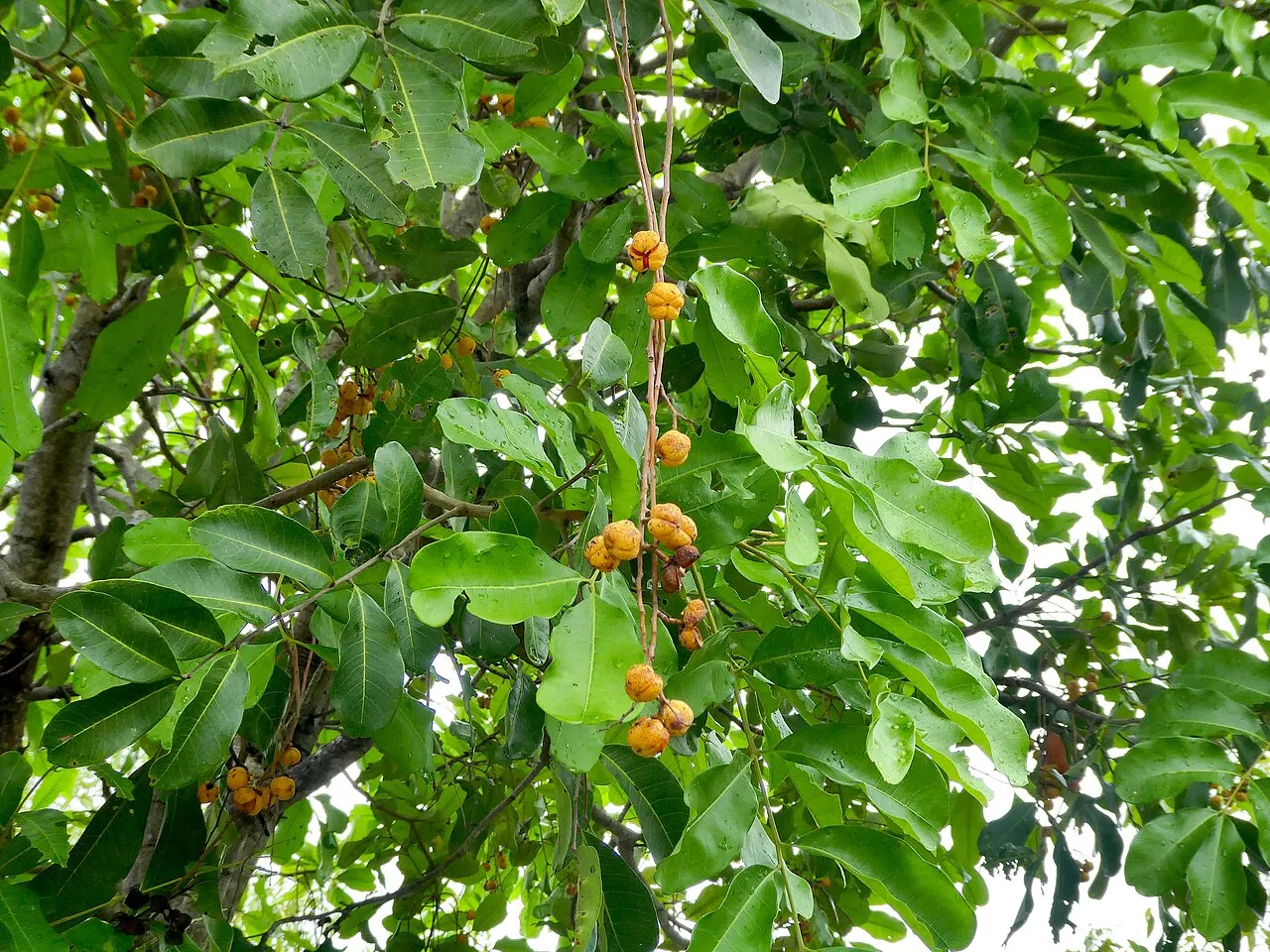
The capsules in the photograph are the mechanism. They ripen yellow-orange, split open to reveal a seed with a bright red fleshy coat, and birds take them — fish crows in particular are efficient dispersers, and they carry seed well away from the planted tree.
What they carry it into is the problem. Carrotwood invades coastal dunes, tropical hammocks, mangrove and cypress swamps, scrub, and coastal strands — several of the most constrained and least replaceable habitats in the state. In mangrove systems it establishes where there is no comparable native competitor, and a stand of carrotwood is not a mangrove.
That is the difference between a weed and a Category I invasive: this one changes what the place is.
Identifying it
Worth knowing, because carrotwood is still standing in a great many Florida yards and streets and is often mistaken for something else.
- Compound leaves with glossy leaflets in pairs, and distinctively blunt or notched leaflet tips rather than pointed ones.
- Single, straight trunk with grey bark. Cut or scraped bark shows orange inner wood — this is where the name comes from and it is the surest confirmation.
- Warty yellow-orange capsules, three-lobed, splitting to show red-coated seed.
- 25 to 35 feet tall at maturity, with a dense rounded crown.
- Evergreen, tolerates full sun and high aerosol salt exposure, which is how it ended up specified for coastal plantings in the first place.
Seedlings turn up under bird perches — fence lines, power lines, the edges of shrub beds — rather than near the parent tree.
If you have one
The tree is doing exactly what the listing describes, so the question is what you do about it.
Remove the fruit if you keep the tree. Every seeding season sends more into the hammocks. This is the minimum.
Pull seedlings as you find them. Small ones come out of sand easily, and they are far cheaper to deal with now than as saplings.
Removing the tree is the real answer, and carrotwood resprouts vigorously from a cut stump, so cutting alone will not do it — stump treatment is needed. For a mature tree near structures this is a job for a professional, and for the method and timing your county extension office is the right call. Florida has well-developed guidance on this species specifically, and it varies by site and by what is growing around it.
Outside Florida
Carrotwood is also planted in parts of southern California and Hawaii, where it is hardy in zones 10 and 11 and the same salt tolerance makes it attractive for coastal streets.
The Florida listing is a Florida law and does not apply elsewhere. The biology does. A tree that is bird-dispersed into coastal and wetland habitat in one subtropical climate has the same capacity in another, and the Florida record is the best available evidence of what it does when it gets loose. Before planting one anywhere subtropical and coastal, check your own state and county invasive species lists — several jurisdictions have been tightening on this species.
The short version
An attractive salt-tolerant tree that became a Category I invasive and, since 1999, a listed noxious weed in Florida — illegal to plant, possess or move there without a permit, and absent from the trade. Birds spread the red-coated seed into dunes, hammocks and mangrove swamps. Identify it by blunt-tipped compound leaflets, warty orange capsules and orange inner wood. If one is on your property, strip the fruit, pull the seedlings, and talk to your extension office about taking it out properly.
- carrotwood
- cupaniopsis
- invasive plants
- florida
- noxious weeds