Trees
How to Grow and Care for Norway Spruce
A fast 60-foot conifer for cold climates that fails in hot ones — and the zone number alone will mislead you. Here is where it works and what kills it.
The Garden Magic Hub
- Zone
- 2–7
- Light
- Full sun
- Water
- Moderate
- Level
- Beginner
On this page
Norway spruce is the fast, tough, large evergreen that cold-climate gardeners plant for shelter — and one of the more common mistakes in warmer ones.
The zone number will mislead you
NC State Extension gives hardiness as zones 2a to 7b, which on paper covers most of the country.
The qualification matters more than the range. The tree dislikes heat, wet feet, and hot dry summers, and NC State states directly that it is unsuitable for zone 7 in the southern US.
That is the difference between cold hardiness and heat tolerance, and zone maps only measure the first. A zone 7 winter in Pennsylvania and a zone 7 summer in Georgia are not the same proposition for this tree. Norway spruce is a northern European species; it wants cool summers and it declines steadily in humid southern heat.
Where it works: the upper Midwest, the Northeast, the mountain west, the Canadian border states, and cooler upland parts of the mid-Atlantic.
Where it does not: the southeast, the hot south-central states, and anywhere with long humid summers, whatever the winter low says.
Size, honestly
40 to 60 feet tall and 25 to 30 feet wide, with a rapid growth rate.
This is the part people underestimate, because the tree they buy is four feet tall and the one in the catalogue photograph is not. Norway spruce planted as a foundation shrub becomes a problem within a decade — it will swallow a single-storey house.
Plant it where a 60-foot tree with a 30-foot skirt is welcome, or buy a dwarf cultivar, of which there are many. The dwarf forms are excellent for foundation plantings, specimens and accents, and are a completely different proposition from the species.
Identifying it
Two features, both visible on the tree:
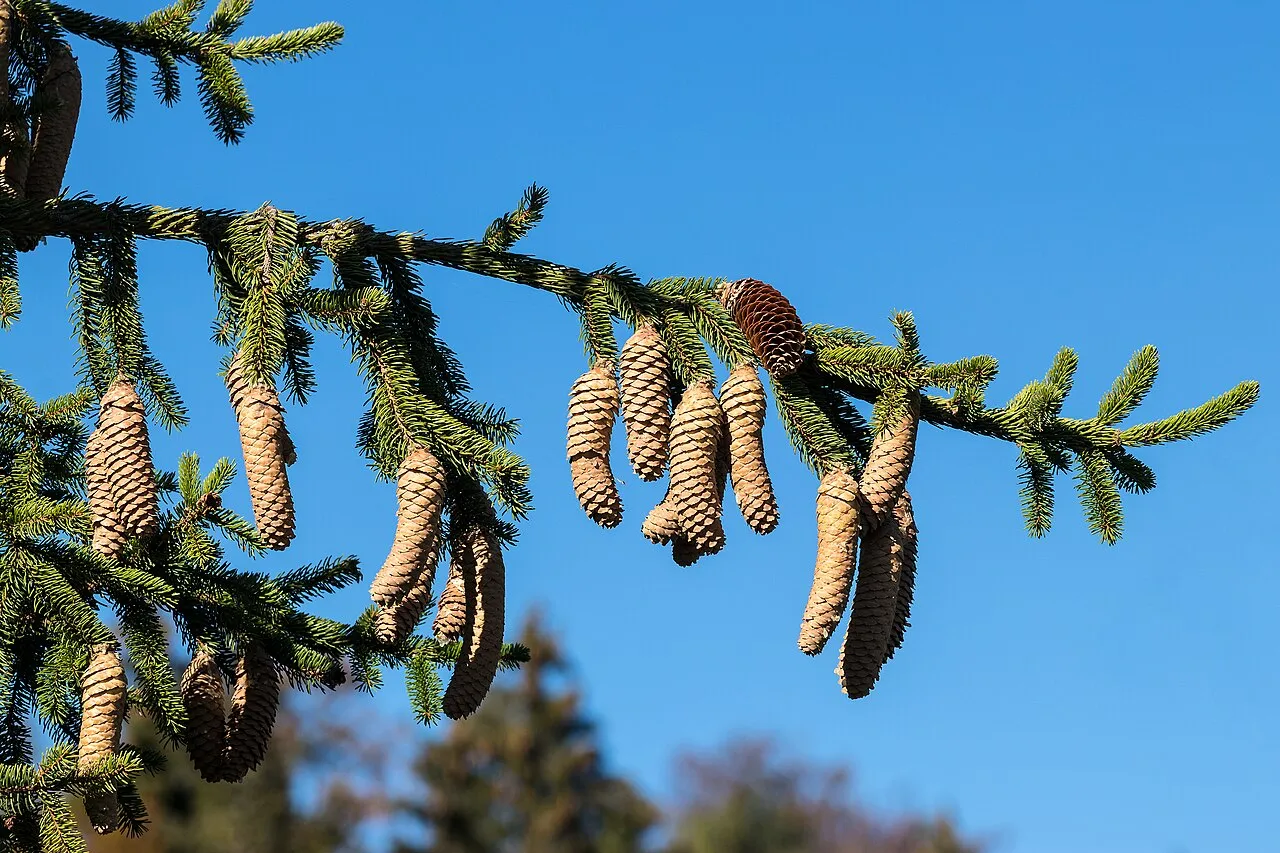
Cones. Pendulous, 4 to 6 inches long, green to violet when young and maturing silvery-brown. These are the largest cones of any commonly planted spruce, and they hang straight down. If you find a big cylindrical cone under a spruce, this is almost certainly the tree.
Needles. Up to an inch long, green, four-sided and saber-like — roll one between your fingers and it turns, unlike the flat needles of a fir or hemlock.
Mature trees also develop distinctly drooping branchlets hanging from upswept main branches, which gives the species its characteristic curtained silhouette.
Site and soil
Full sun. It will tolerate light shade when young but thins badly in real shade.
Soil should be moderately moist, well-drained, sandy and acidic. The two things to avoid are the ones already mentioned — waterlogging and drought. Norway spruce has a relatively shallow root system, so it suffers in prolonged dry spells and is more prone to windthrow than deep-rooted species on exposed sites.
Mulch a wide circle rather than a narrow ring, keep mulch off the trunk, and water young trees through their first few summers.
What it is good for
Windbreaks and screens in cold climates — this is its main job, and it does it better than almost anything. Fast growth, dense evergreen cover to the ground when grown in the open, and genuine toughness.
Also a fine specimen tree where there is room, and the source of a large share of cut Christmas trees in Europe.
For a windbreak, space trees so the mature crowns will just touch — around 20 to 25 feet — rather than the tight spacing that looks right on planting day and produces a row of bare-stemmed trees competing with each other in twenty years.
Problems
Pests: aphids, bagworms, budworms, borers and red spider mites. Spider mites are worth watching in hot dry summers, when they cause a bronzed, dull look to the interior needles.
Diseases: cytospora canker, wood decay, needle cast and rust.
Cytospora canker deserves particular attention because it is the classic killer of mature landscape spruces. It typically shows as branch dieback starting in the lower crown and moving up, with white resin bleeding on affected branches. There is no cure — management is pruning out affected limbs in dry weather and reducing stress on the tree. Since drought stress and heat are what predispose spruces to it, this is the same story as the zone caveat above: a Norway spruce planted somewhere too warm and dry does not die of heat directly, it dies of canker a decade later.
The short version
A fast 40-to-60-foot conifer for genuinely cool climates. Full sun, acidic soil that drains but does not dry out, and plenty of room. Identify it by the long hanging cones. Do not plant the species near a house, and do not plant it at all in the humid south — the zone number says yes and the summer says no.
- norway spruce
- conifers
- windbreak
- cytospora canker
- screening