Succulents
How to Grow and Care for African Milk Tree
African milk tree is not a cactus, and its milky sap can blister skin and seriously damage eyes. Here is how to handle, site and grow it safely.
The Garden Magic Hub
- Zone
- 9–11
- Light
- Partial sun
- Water
- Low
- Level
- Beginner
On this page
African milk tree is one of the easiest houseplants there is, and one of the few genuinely worth a safety warning before the care instructions.
Read this part first
Euphorbia trigona bleeds a milky white latex sap whenever it is cut, broken or knocked. NC State Extension is unambiguous about what it does:
- On skin, the sap causes “skin irritation, rash, blisters.”
- In the eyes, “severe eye irritation with contact.”
- Swallowed, “severe gastroenteritis, vomiting, diarrhea, and convulsions can occur.”
The active compounds are diterpenoid euphorbol esters. NC State’s handling instruction is to wear gloves, and to keep the plant away from children and pets.
The practical risks are specific and easy to underestimate. A stem snapped while moving the plant drips sap. Pruning without gloves puts it on your hands, and rubbing an eye afterwards is the injury that sends people to hospital — eye exposure to euphorbia sap is a real ophthalmic emergency, not a stinging nuisance.
None of this makes it a bad houseplant. It makes it a plant to site out of traffic, prune with gloves and eye protection, and wash your hands after.
It is not a cactus
Despite being sold beside them and looking the part, this is not a cactus. It is a succulent spurge in the family Euphorbiaceae, native to Central Africa.
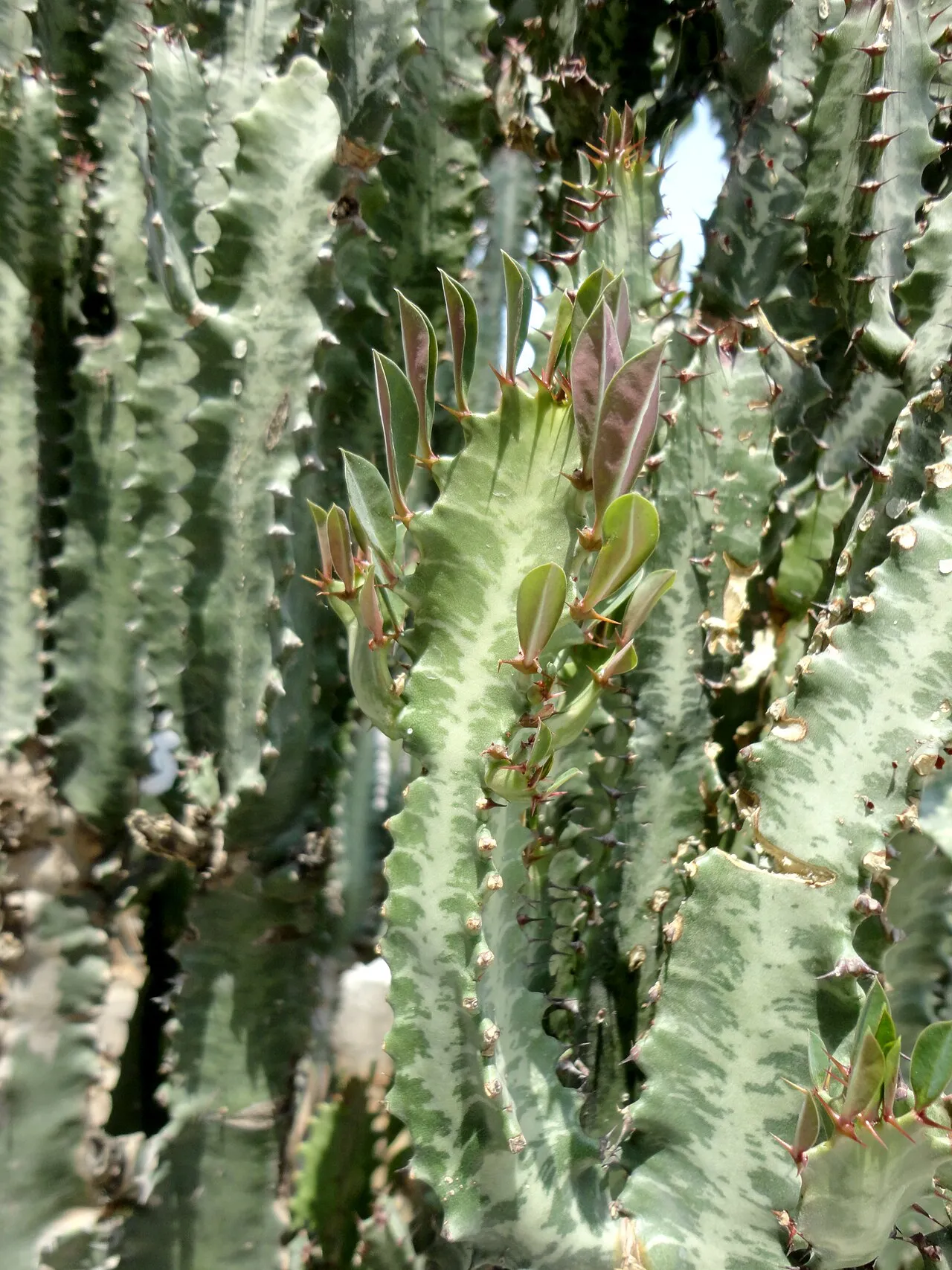
The tell is visible on any healthy plant: small teardrop-shaped leaves growing along the ridges of the stems, alongside paired spines. True cacti do not carry leaves like that, and they do not bleed white latex — cactus sap is clear.
This matters practically, because “treat it like a cactus” is roughly right for watering and wrong for handling.
Size and hardiness
Hardy in zones 9a to 11b, and grown as a houseplant everywhere colder.
Do not underestimate the eventual size: NC State gives 6 to 12 feet tall and 5 to 10 feet wide. Indoors it grows more slowly and stays smaller, but a well-grown plant will reach the ceiling in time, and the upright columns get heavy and top-tip out of undersized pots. Use a heavy pot.
Light
Partial sun outdoors, bright indirect light indoors.
Note that this is less than a desert cactus wants. Full unfiltered sun through glass can scorch the stems, particularly on the red-leaved ‘Rubra’ form. An east or west window, or a few feet back from a south-facing one, suits it.
Too little light produces thin, pale, stretched growth that will not thicken up again.
Water
Little, and only when the plant has dried out. NC State’s test is to water when the soil feels dry 1 to 2 inches down, and overwatering causes root rot.
Water less in winter, when growth slows. A stem that is soft, yellowing or blackening at the base is rotting, and by that point the usual remedy is to take a cutting from the healthy top and start again.
Soil
Well-drained sandy or loamy soil at acid to neutral pH, or a cactus and succulent mix in containers. A pot with a drainage hole is not optional.
Propagation, carefully
Stem cuttings and layering both work, and cuttings are straightforward — with one euphorbia-specific step.
Wear gloves and eye protection. Cut a length of stem, then rinse or blot the cut ends to stop the sap flowing — dipping the cut end briefly in cool water works — because the latex will otherwise seal into a mass that prevents rooting. Let the cutting callus over for several days in a dry, shaded spot, then insert it into dry succulent mix and water sparingly until roots form.
Do not compost the trimmings where pets browse, and wash tools afterwards.
Problems
Root rot from overwatering is the main one, and it is nearly always the cause of death.
Otherwise the usual indoor succulent pests — mealybugs in particular, which hide in the ridges and around the spine pairs where they are easy to miss.
The short version
Bright indirect light, cactus mix, water only when it is dry two inches down, and a heavy pot for a plant that gets tall. Treat every cut as a hazard: gloves, eye protection, and hands washed afterwards. Site it away from where children, pets and elbows go.
- african milk tree
- euphorbia
- toxic plants
- succulents
- cuttings