Tropical Plants
How to Grow and Care for Australian Tree Fern
Fast, dramatic and up to 50 feet, with fronds reaching twenty feet across. Also naturalised and invasive in Hawaiian forests, which is worth knowing first.
The Garden Magic Hub
- Zone
- 8–11
- Light
- Shade
- Water
- High
- Level
- Advanced
On this page
The Australian tree fern is the fastest route to a prehistoric-looking garden, and one of the few ornamental ferns that comes with a conservation warning attached.
Read this first if you garden in Hawaii
NC State Extension states it plainly: “This tree has naturalized in some forests in Hawaii and is considered invasive. This tree has weedy tendencies.”
The mechanism is spores — millions of them, wind-carried, germinating readily in the humid forest understorey. In Hawaii it displaces the native Cibotium tree ferns (hāpuʻu), which are keystone species in those forests.
If you garden in Hawaii, do not plant it, and consider the native hāpuʻu instead. In mainland zones 8 to 11, it is much less of a concern — but “weedy tendencies” is worth taking at face value if you are near natural humid woodland.
The name has moved
Three names are in circulation and all refer to this plant. NC State gives the accepted name as Sphaeropteris cooperi, with Alsophila cooperi and Cyathea cooperi as synonyms. The USDA PLANTS Database still files it as Cyathea cooperi, and that is the name most nurseries use.
The scale is the point
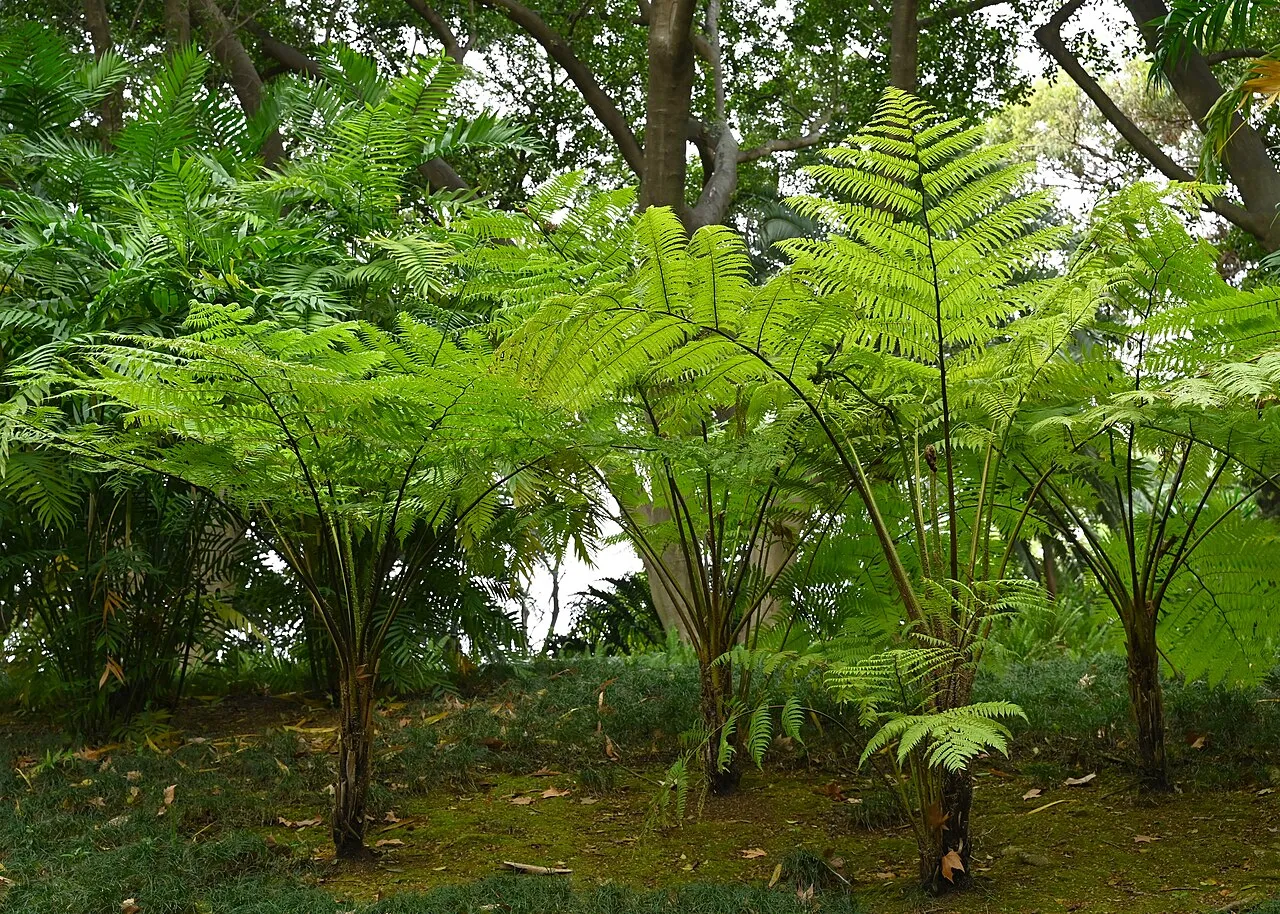
Height 15 to 50 feet, though NC State notes it typically reaches 15 to 25 feet in cultivation, with a spread of 10 to 12 feet. Growth is rapid — this is not a plant that takes decades.
The fronds are the startling part: long, lacy, bipinnately compound, reaching 13 to 20 feet in length. A mature specimen casts a crown wider than many small trees.
The trunk is not wood. It is brown and fibrous, marked with oval leaf scars encircling it where old fronds have fallen. Structurally it is a mass of adventitious roots grown around a slender stem — which matters practically, because that trunk absorbs water. Watering the trunk as well as the soil is genuinely useful for this plant, unlike almost any tree.
Young fiddleheads are covered in stiff white hairs, which can irritate skin — worth gloves when handling new growth.
Conditions
Hardiness: zones 8a to 11b.
Light: partial to full shade preferred, though NC State notes tolerance of dappled sunlight, deep shade and even full sun. In practice, more sun demands more water and humidity; a plant in full sun in dry air scorches.
Temperature: warm and humid, 65 to 80°F. This is the real constraint. It is not merely frost-tender — it resents dry air at any temperature.
Soil: moist, well-drained, loamy or sandy, acid to neutral.
Water: generously and consistently. Tree ferns have shallow, fine root systems and no drought reserve, and a specimen that dries out badly often does not recover — the crown dies and the trunk has no dormant buds to resprout from.
Growing it in a pot
Outside zone 8, that is the only option, and it works up to a point. Use a large container, keep it in shade outdoors through summer, bring it into a bright frost-free space for winter, and mist or run a humidifier.
Be realistic about ceiling height. A plant that gains several feet a year in a conservatory quickly becomes unmanageable, and unlike most houseplants you cannot prune it back — cutting the crown kills the plant.
Propagation
By spores only. There are no divisions, no offsets, no cuttings — a tree fern is a single growing point on a single trunk.
That also means damage to the crown is permanent. Site it out of wind and away from where it will be knocked.
The short version
Fast, spectacular, and large — 15 to 25 feet with fronds up to twenty. Shade, constant moisture, humidity and 65 to 80°F, with water applied to the fibrous trunk as well as the soil. Never cut the crown. And if you garden in Hawaii, grow the native hāpuʻu instead.
- australian tree fern
- cyathea
- tropical plants
- invasive plants
- humidity