Tropical Plants
How to Grow and Care for Black Bat Flower
Tacca chantrieri is a yam relative that wants orchid conditions: humidity, airflow and shade. Get those three right and the rest is straightforward.
The Garden Magic Hub
- Zone
- 10–11
- Light
- Shade
- Water
- High
- Level
- Advanced
On this page
The black bat flower is the plant people photograph and then fail to grow. It has a reputation for being temperamental, which is fair, but the requirements are a short and specific list rather than a mystery.
What it actually is
Tacca chantrieri is native to the tropical forests of southeast Asia and belongs to Dioscoreaceae — the yam family. It is not an orchid, not an aroid, and not related to anything else you are likely to be growing.
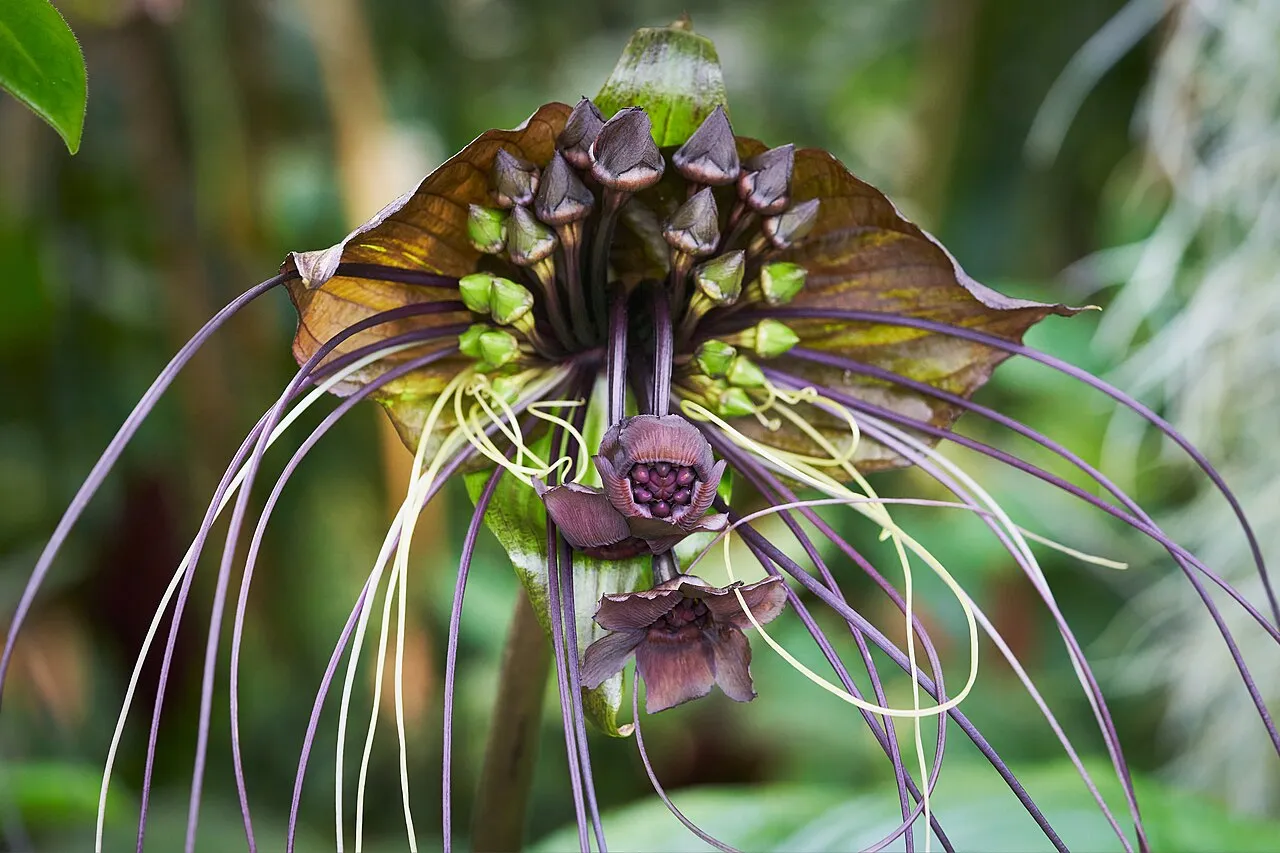
The structure of the flower is worth understanding, because almost everyone describes it wrongly. The dark “wings” are bracts, up to a foot across. The long trailing “whiskers” are threadlike bracteoles, which UF/IFAS measures at 8 to 10 inches long. The actual flowers are the small cluster of dark purple cups in the centre.
Grow it like an orchid
This is the most useful framing available, and UF/IFAS uses it directly: bat flower can be grown in the conditions orchids are grown in — ample humidity, strong airflow, and low to moderate light.
Those three together are the whole difficulty. Most people can supply one or two.
Humidity is the requirement people underestimate. UF/IFAS states the species “requires a humid climate to survive,” and recommends a saucer beneath the pot and regular misting indoors. A heated living room in winter is far too dry, and this is the usual cause of failure — a plant that limps along and never flowers.
Airflow matters as much, and it is the one people get wrong when they try to solve humidity by sealing the plant into a bag or a closed case. High humidity plus still air invites rot. You want moving, moist air — which is exactly what a well-run orchid setup provides.
Light: shade outdoors; bright but not direct light indoors. Direct sun scorches the leaves and bleaches the bracts.
Soil and water
UF/IFAS gives a specific mix: 50% pine bark, 40% peat moss, 10% sand, or a similar combination. That is a coarse, open, acidic medium — again, much like an orchid or aroid mix rather than standard potting compost.
Water to keep the soil consistently moist. This plant does not want to dry out between waterings, which sets it apart from most difficult houseplants where the advice runs the other way. The open mix is what makes constant moisture safe: it holds water without going anaerobic.
Standard potting soil in a plastic pot, kept constantly moist, will rot the rhizome. The mix and the watering regime only work together.
Temperature and hardiness
Hardy outdoors only in the warmest zones — roughly 10 to 11 — and grown under glass or indoors everywhere else. It needs protection from frost and from cold drying winds in winter.
Everywhere else in the US, treat it as a warm greenhouse or indoor plant.
Flowering
UF/IFAS gives bloom in Florida as late summer through fall. A well-established plant can produce several inflorescences in a season; a stressed one produces none, and lack of flowering is usually a humidity or light problem rather than a feeding one.
Propagation
By tuber or rhizome division, and occasionally from seed. Division is the practical route, done when repotting, with each piece keeping some roots and a growing point.
Seed is slow and germination is erratic, which is part of why plants are expensive.
Expectations
UF/IFAS describes it as “a collector’s item” that “can be difficult to find in garden centers” and requires specialised care — but also that it “can do very well” when the conditions match orchid growing.
That is the honest summary. This is not a beginner houseplant, and buying one for a dry centrally heated room is buying a slow disappointment. In a humid bathroom with a window, a greenhouse, or alongside an orchid collection under lights with a fan running, it is genuinely growable.
The short version
A yam relative that wants orchid conditions: shade or bright indirect light, constant moisture in a coarse bark-based mix, high humidity, and air actually moving through it. Divide the rhizome to propagate. If you cannot supply humidity and airflow together, this is not the plant to start with.
- black bat flower
- tacca
- humidity
- shade plants
- collector plants