Outdoor Plants & Flowers
How to Identify and Treat Black Spot on Roses
Feathery-edged black spots that yellow the leaf and strip the plant from the bottom up. How to confirm it and what actually slows it.
The Garden Magic Hub
- Zone
- 5–9
- Light
- Full sun
- Water
- Moderate
- Level
- Intermediate
On this page
Identifying it
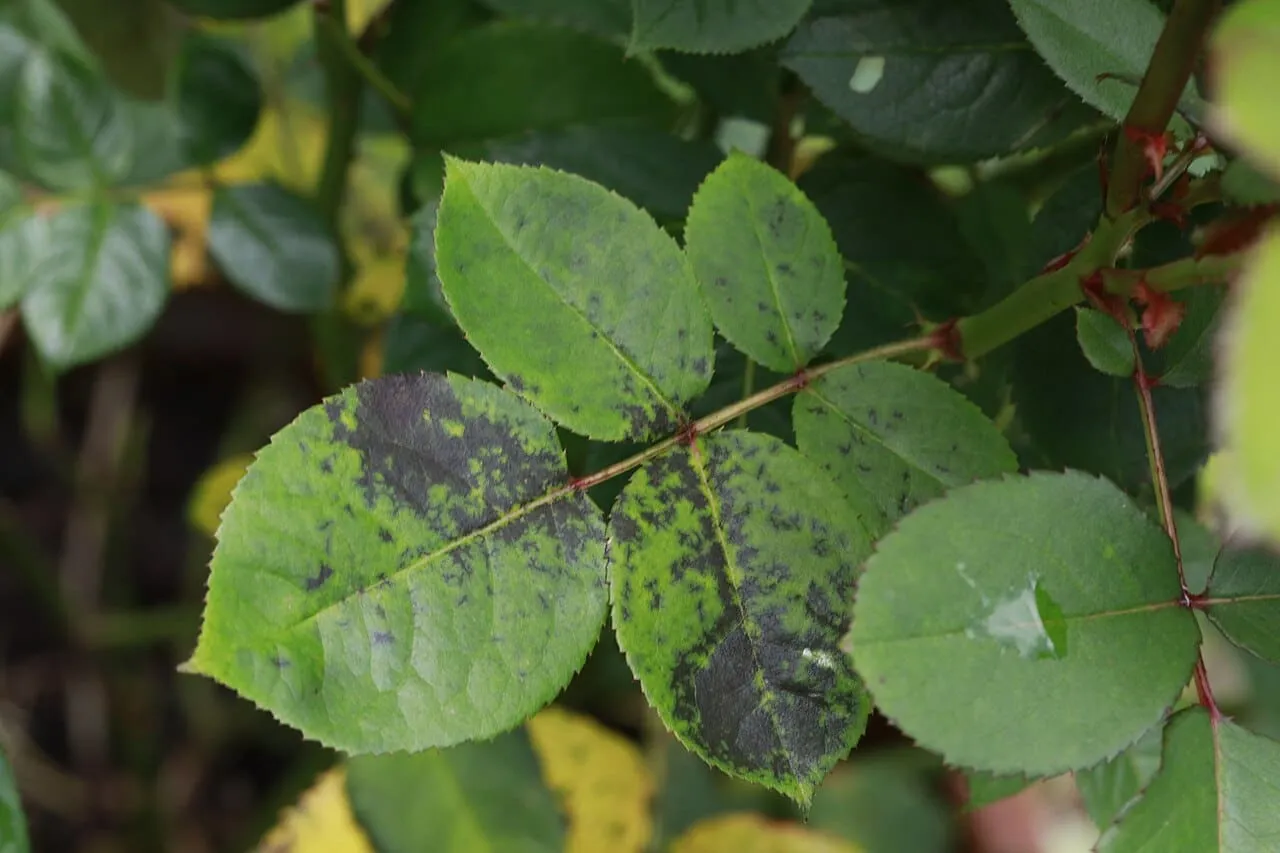
Black spot is caused by the fungus Diplocarpon rosae, and it is the most damaging rose disease in most of the country.
University of Maryland Extension describes the first sign precisely: “feathery-edged, black spots on lower leaves.”
That feathered margin is the diagnostic detail. Most other leaf spots have clean, defined edges; black spot lesions fray outward into the surrounding tissue. Spots grow to around half an inch and develop a yellow halo.
What follows is characteristic. Maryland: “the leaves turn yellow and drop off. The disease continues up the stems until the entire plant becomes defoliated.”
It moves bottom upward, which is worth remembering — a rose losing its lowest leaves first, in a rising line, is almost always black spot.
Canes are affected too. Maryland describes stem lesions as “dark, irregular blotches that eventually become blistered.”
The condition it needs
One sentence from Maryland explains the entire control strategy: “Leaves are most susceptible when young and must remain moist overnight before infection can occur.”
Overnight leaf wetness is the requirement. No wet night, no infection. Everything effective against black spot works by shortening the time leaves stay wet, or by removing the spores that would land on them.
Where it comes back from
It does not blow in fresh each spring. Maryland: “Black spot spores can survive in fallen leaves and stem lesions over the winter and will remain active year round on the plant in mild climates.”
Your own fallen leaves and your own infected canes are next year’s inoculum. That makes sanitation unusually effective here — Maryland notes that removing fallen leaves and pruning infected canes “will dramatically slow initial spring infections.”
Management, in order of value
Plant resistant cultivars. The most effective single decision, and the only one that reduces the work permanently. Resistance varies enormously between cultivars.
Clear fallen leaves, all season. Not just in autumn. Rake and bin them — do not compost infected foliage unless your heap reliably gets hot.
Prune out infected canes, and prune for an open centre so air moves through the plant.
Space plants properly. Good air circulation speeds leaf drying, which is the whole mechanism.
Water at soil level, and if you must water overhead, do it early so leaves dry before nightfall. Maryland’s guidance is to restrict irrigation during cloudy, humid weather.
Fungicides, if you go that way
For susceptible cultivars in a humid climate, cultural measures alone often are not enough.
Maryland is realistic about the commitment: “Most people will need to use labeled fungicide sprays every 7-14 days as the first leaves emerge in the spring through the fall.”
Two details matter. Spray before a rain event so the leaves are already protected, and alternate types of fungicide to reduce the chance of resistance developing.
That is a season-long programme, every one to two weeks, for months. It is worth knowing the cost before committing — for many gardeners, replacing a martyr cultivar with a resistant one is the better answer.
- roses
- black spot
- fungal disease
- sanitation