Annuals
How to Grow and Care for Bacopa
The trailing white-flowered basket plant sold as bacopa is not in the genus Bacopa at all. Here is what it actually is, and what it needs.
The Garden Magic Hub
- Zone
- 9–11 (grown as an annual)
- Light
- Partial sun
- Water
- High
- Level
- Beginner
- Season
- Spring, Summer
On this page
The trailing plant sold in every garden centre as “bacopa” has one of the more thoroughly wrong common names in horticulture.
It is not a Bacopa
NC State Extension gives the accepted name as Chaenostoma cordatum, formerly Sutera cordata and Manulea cordata.
And it is explicit about the confusion: this plant is not in the genus Bacopa. There is a separate genus called Bacopa — water hyssop — whose members are primarily aquatic plants.
That matters practically, because the two turn up in completely different contexts:
- Your hanging basket plant is Chaenostoma cordatum, a South African trailing annual.
- Bacopa monnieri, water hyssop or brahmi, is an aquatic plant sold for aquariums and as a herbal supplement.
Care information written for one is useless for the other. If you search “bacopa care” and find advice about submerged planting and water parameters, you have landed on the wrong plant.
What it actually is
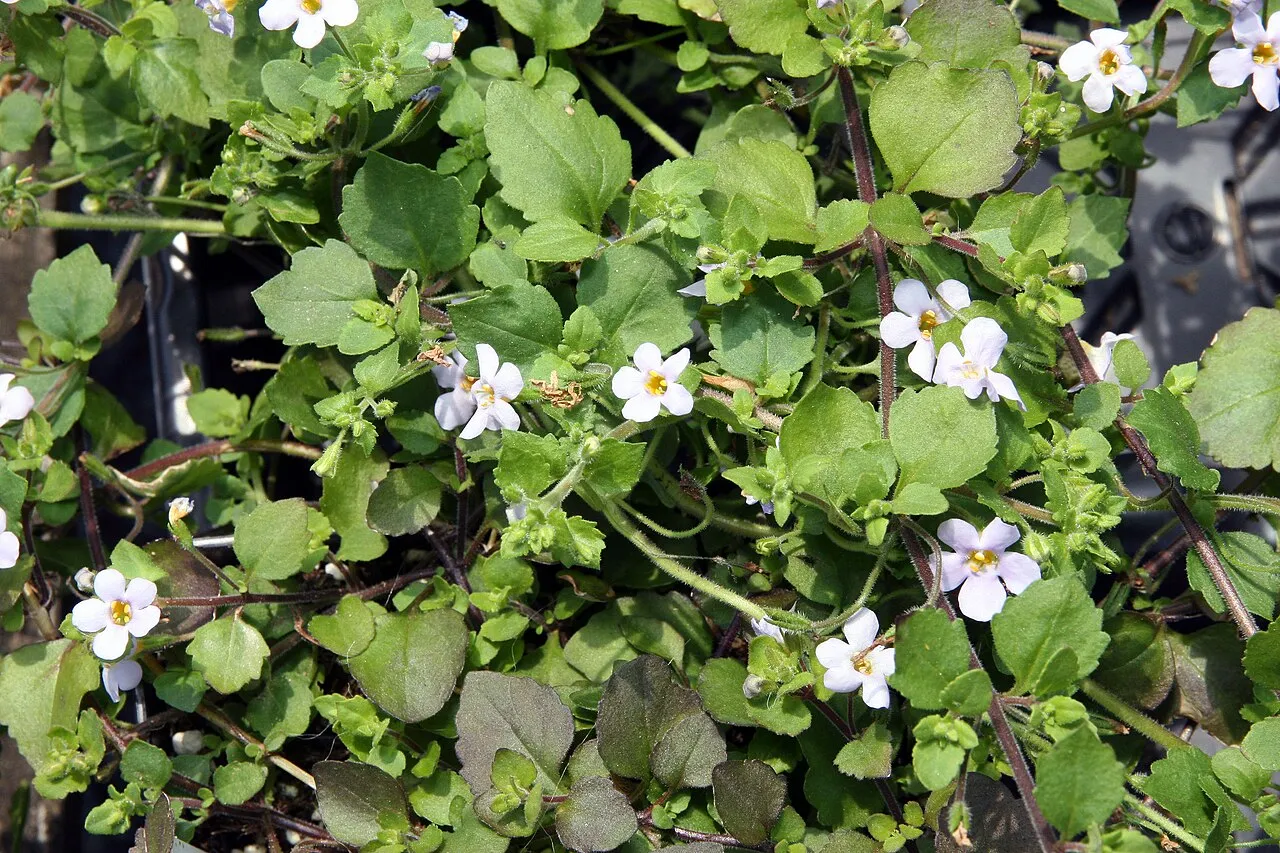
NC State describes it as “a small, evergreen, prostrate, trailing, perennial groundcover” — perennial in zones 9 to 11, and grown as an annual everywhere cooler.
Size: 3 to 6 inches tall with a 1 to 2 foot spread, sprawling rather than mounding, with a rapid growth rate.
That combination — low, wide, fast, and covered in small flowers — is exactly why it became a standard “spiller” in container plantings. It fills gaps and trails over edges without competing with the taller plants beside it.
Light
Bright, indirect light, and it tolerates partial shade.
This is worth noting because bacopa is often sold alongside full-sun bedding plants and planted into blazing containers. It does better with some shelter from harsh afternoon sun, particularly in hot regions.
Water — the thing to get right
Moist, well-drained loamy soil at a slightly acidic to neutral pH.
Consistent moisture is the operative requirement. A shallow-rooted trailing plant in a hanging basket dries out faster than almost anything else in the garden — baskets are exposed on all sides and hold little compost. In hot weather, check daily.
Mixing a moisture-retaining compost, using a larger basket than looks necessary, and grouping baskets together all reduce the problem more than any watering schedule.
One honest note: NC State does not address whether flowering stops after a plant dries out, and I have not found an extension source that does. The widely repeated claim that bacopa “won’t rebloom after drying out” may be true, but treat it as a nursery observation rather than an established fact. Either way, consistent moisture is what the plant wants.
Problems
NC State records no significant insect pests or diseases, while noting to watch for aphids, thrips and whiteflies, and susceptibility to root rot, powdery mildew and viruses.
Root rot is the flip side of the moisture requirement — consistently moist is not the same as waterlogged, and a basket without drainage holes will rot the plant. Powdery mildew follows crowding and still air.
The short version
A South African trailing annual, Chaenostoma cordatum, with nothing to do with the aquatic genus Bacopa. Bright indirect light or part shade, consistently moist but free-draining compost, and a bigger basket than you think you need. Then it flowers all season with very little else asked of it.
- bacopa
- hanging baskets
- trailing plants
- container plants
- plant names