Annuals
How to Grow and Care for Castor Bean
A spectacular six-foot annual and one of the most poisonous plants sold in garden centres — a few seeds can kill. Here is how to grow it, if you should at all.
The Garden Magic Hub
- Zone
- 9–11 (grown as an annual)
- Light
- Full sun
- Water
- Moderate
- Level
- Beginner
- Season
- Summer
On this page
Castor bean is one of the most dramatic plants you can raise from seed in a single season — six to ten feet of bronze-purple palmate foliage in four months. It is also genuinely dangerous, and that has to come first.
The toxicity
NC State Extension rates it high severity, which is the top of their scale, and states the consequence plainly:
“It can be fatal if only a few seeds are ingested.”
The toxins are ricin, a phytotoxalbumin, and ricinine, an alkaloid. They are present in the seeds, leaves, flowers and sap — the seeds most concentrated of all.
Symptoms, per NC State: “immediate or delayed nausea, vomiting, abdominal pain, bloody diarrhea, weakness… difficulty breathing… may be fatal.” The delay matters — someone can swallow seeds and feel fine for hours.
Handling is a risk too. NC State: “Handling the foliage may cause severe contact dermatitis. Wear gloves and other protective equipment.”
It is toxic to cats, dogs, horses and livestock as well as people.
And NC State’s siting instruction is unambiguous:
“Do not plant this in areas where children or pets play due to its toxicity.”
Why the seeds specifically
The realistic accident is not someone eating a leaf. It is a child eating the seeds, and there are two reasons they are the hazard.
They are attractive. Castor seeds are glossy, smooth, bean-sized and beautifully mottled in brown, grey and black — they look like decorative beans or beetles, and people collect them.
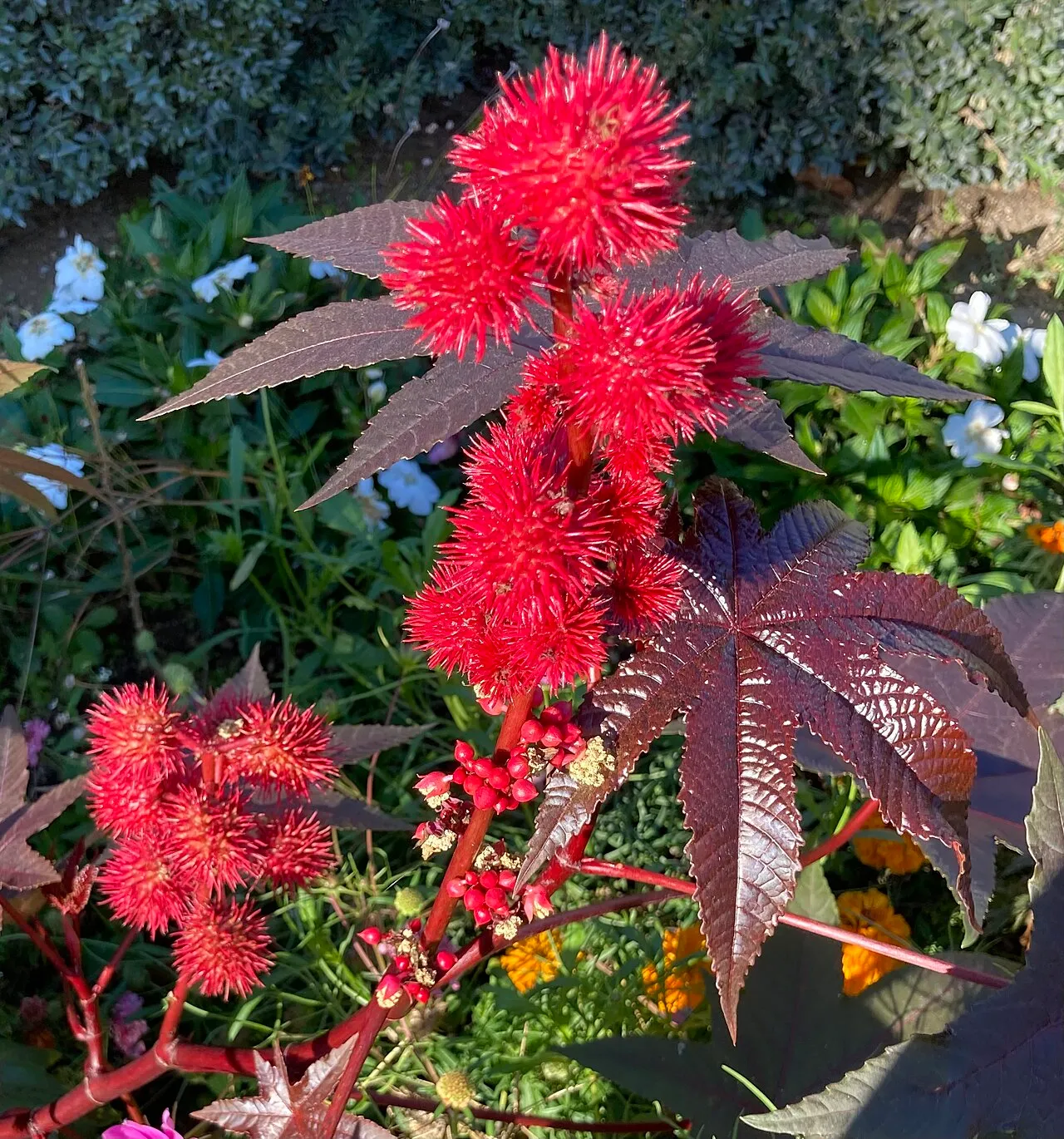
They are abundant and they scatter. The spiny pods shown above dry, split and fling seeds several feet.
The single most effective safety measure is to cut the seed pods off while they are still green, before they dry and split. This also stops the plant self-seeding, which matters for the next section.
Where it is regulated
NC State records it as a Category II invasive in Florida and a noxious weed in California, noting that it readily self-seeds.
So in California and Florida, do not plant it. Elsewhere, removing the pods before they ripen keeps it in bounds.
Should you grow it at all?
An honest answer: it depends on your household.
If you have young children, or dogs that chew, or livestock — no. The consequence of getting it wrong is too severe, and there are other big dramatic annuals. Cannas, dahlias, and tall amaranths give height and bold foliage without a fatal dose in the seed head.
If you garden alone, or with adults who know what it is, and you deadhead the pods — it is manageable, and it is a magnificent plant.
Either way, label it, and tell anyone else who gardens with you what it is.
Growing it
Everything about the culture is easy, which is part of the problem.
Hardiness: a herbaceous perennial in zones 9a to 11b, grown as an annual everywhere colder — and it reaches full size in one season regardless.
Size: 6 to 10 feet tall and 2 to 4 feet wide, with a rapid growth rate.
Light: full sun, six hours or more.
Soil: loam or sand, good drainage, kept moist, tolerant of acid through alkaline pH. It is a hungry, thirsty plant and responds strongly to rich soil and regular water.
From seed: sow indoors a few weeks before the last frost or direct sow once the soil is warm. Soaking the seed overnight speeds germination — wear gloves and wash your hands afterwards, and do not soak them in anything used for food.
Stake tall plants in exposed sites. The stems are hollow and snap in wind.
The short version
A fast, spectacular six-to-ten-foot annual for full sun and rich moist soil. It is also rated high-severity poisonous, fatal in small quantities, a contact irritant, and regulated in California and Florida. Cut the pods off green, wear gloves, and do not plant it where children or pets play.
- castor bean
- ricinus
- toxic plants
- ricin
- architectural plants