Perennials
How to Grow and Care for Anemone
Anemone covers three unrelated garden plants with different seasons, planting methods and hardiness. Work out which one you have before you plant it.
The Garden Magic Hub
- Zone
- 4–10 (varies by type)
- Light
- Partial sun
- Water
- Moderate
- Level
- Intermediate
- Season
- Spring, Fall
On this page
“Anemone” is not one plant. It is a label attached to at least three quite different garden plants that flower in different seasons, are planted in different ways, and survive different winters.
Almost every anemone problem starts with advice for one group being applied to another. So begin by identifying which you have.
The three groups
| Grecian windflower | Poppy anemone | Japanese anemone | |
|---|---|---|---|
| Botanical name | Anemone blanda | Anemone coronaria | Anemone × hybrida, A. hupehensis |
| Bought as | dry tubers | dry tubers | potted plants |
| Flowers | April–May | mid-spring | late summer to fall |
| Height | about 6 inches | about 12 inches | 2.5–3 ft in bloom |
| Hardiness | roughly zones 5–9 | zones 7–10 | zones 4a–8b |
If you bought a bag of shrivelled brown lumps in autumn, you have one of the first two. If you bought a leafy plant in a pot that flowers in September, you have the third.
Grecian windflower (Anemone blanda)
Low, early and easy — 6 inches high and wide, with cup-shaped daisy-like flowers mainly in purple-blue, plus pink and white forms, in April and May.
Plant the tubers in fall, and soak them first. This is the step people skip and it matters: the tubers arrive bone dry and hard, and soaking rehydrates them so they can start growing. Overnight is the usual recommendation; a few hours is the minimum.
Plant 2 to 3 inches deep and 3 to 5 inches apart. The tubers are knobbly with no obvious top or bottom — do not agonise over orientation, since the shoots will find their way up regardless. Plant them in generous drifts; individually they are too small to register.
They naturalise well in light shade under deciduous trees, coming and going before the canopy closes.
Poppy anemone (Anemone coronaria)
The florist’s anemone — 2.5-inch flowers in intense blue, red or white with dramatic black centres, on 12-inch stems in mid-spring.
The important detail is hardiness: zones 7 to 10, considerably tenderer than the other two. In zone 6 and colder they are grown as annuals, planted in spring for early summer flowers, or lifted and stored.
Soak the tubers before planting, as with blanda.
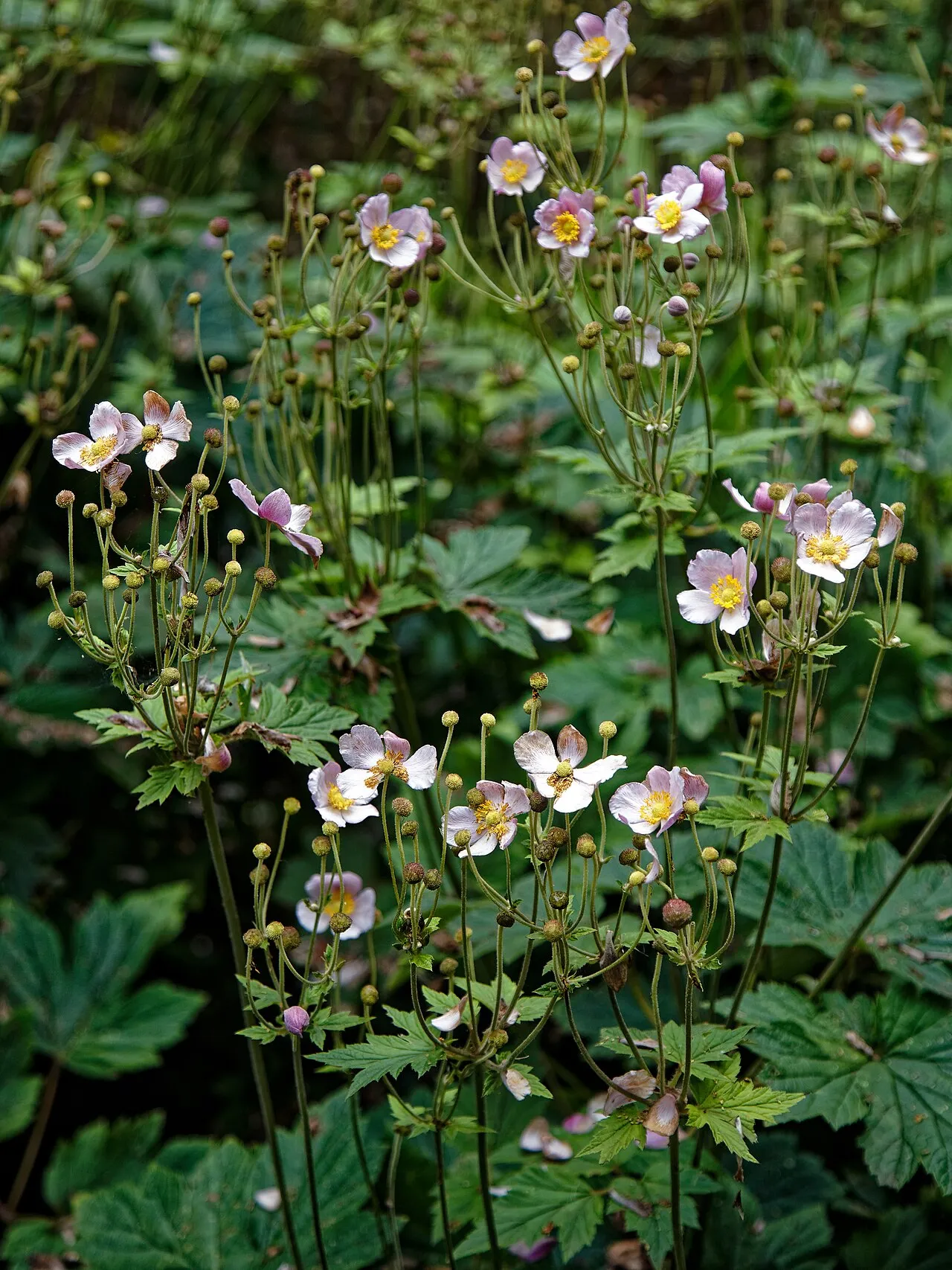
Japanese anemone (Anemone × hybrida)
The one most people mean by “anemone” as a border perennial, and the only group in the table that flowers in autumn.
NC State Extension gives zones 4a to 8b, foliage about 1 to 1.5 feet with flowers carried to 2.5 or 3 feet on wiry branching stems, and a spread of 4 to 6 feet. That spread is worth registering before you plant one in a small bed.
Light: full sun to partial shade. In southern gardens NC State specifically recommends part shade “to prevent burning the foliage and drying out.”
Soil: this is the fussy part. They want soil that is “moist but well-drained and fertile” and that is “not allowed to dry out” — while also avoiding wet soils. In practice that means good soil with organic matter, mulched, and watered in drought. They will not tolerate baking dry shade, which is where people often put them.
Be patient. NC State notes they “may be slow to establish.” A Japanese anemone that sulks in its first year is behaving normally. By year three the same plant is often spreading further than you wanted.
Then be less patient. They spread by rhizomes and can make an effective groundcover given room — which is another way of saying they run. In a mixed border, expect to dig back the edges. Propagate by division or root cuttings.
Taller stems may need staking, particularly in rich soil or part shade.
Problems
Mostly on the Japanese group, which is the one that stays in the ground year-round: occasional flea beetles, caterpillars and slugs, and a longer disease list — Synchytrium leaf gall, downy mildew, Septoria leaf spot, powdery mildew and some viruses.
None of these is usually fatal. Spacing for airflow and avoiding overhead watering handles most of them.
A note on natives
The genus is a mix. USDA PLANTS records Anemone as both native and introduced in the lower 48 — the garden plants above are all introductions, but North America has its own species, including thimbleweed and Canada anemone. If you are planting for wildlife rather than display, those are worth looking at instead.
The short version
Identify the group first. Dry tubers in autumn, soaked before planting, 2 to 3 inches deep, for the spring types — and check whether yours is the tender coronaria. Potted plants for autumn flowers, in moisture-retentive soil with afternoon shade in the South, planted where a four-foot spread is welcome.
- anemone
- windflower
- japanese anemone
- spring bulbs
- shade perennials