Perennials
How to Grow and Care for Blackberry Lily
Not a lily but an iris, and named for its seed pods rather than its flowers. The blackberry-like seed clusters are the real reason to grow it.
The Garden Magic Hub
- Zone
- 5–10
- Light
- Full sun
- Water
- Low
- Level
- Beginner
- Season
- Summer, Fall
On this page
Blackberry lily is wrong in its common name twice over. It is not a lily, and the blackberries are not fruit.
It is an iris
NC State Extension places it in the Iridaceae — the iris family — and notes it is not a true lily despite the name.
The flower gives it away once you know: six tepals in the radial arrangement of an iris, borne on branching stems, above flat fans of sword-shaped leaves. Anyone who grows bearded iris will recognise the foliage immediately.
A naming note worth having. NC State gives the accepted name as Iris domestica, with Belamcanda chinensis and Belamcanda flabellata as former names. The USDA PLANTS Database still files it as Belamcanda chinensis. Nurseries use both. All three names refer to the same plant, and nothing about growing it depends on which one is on the label.
The flowers
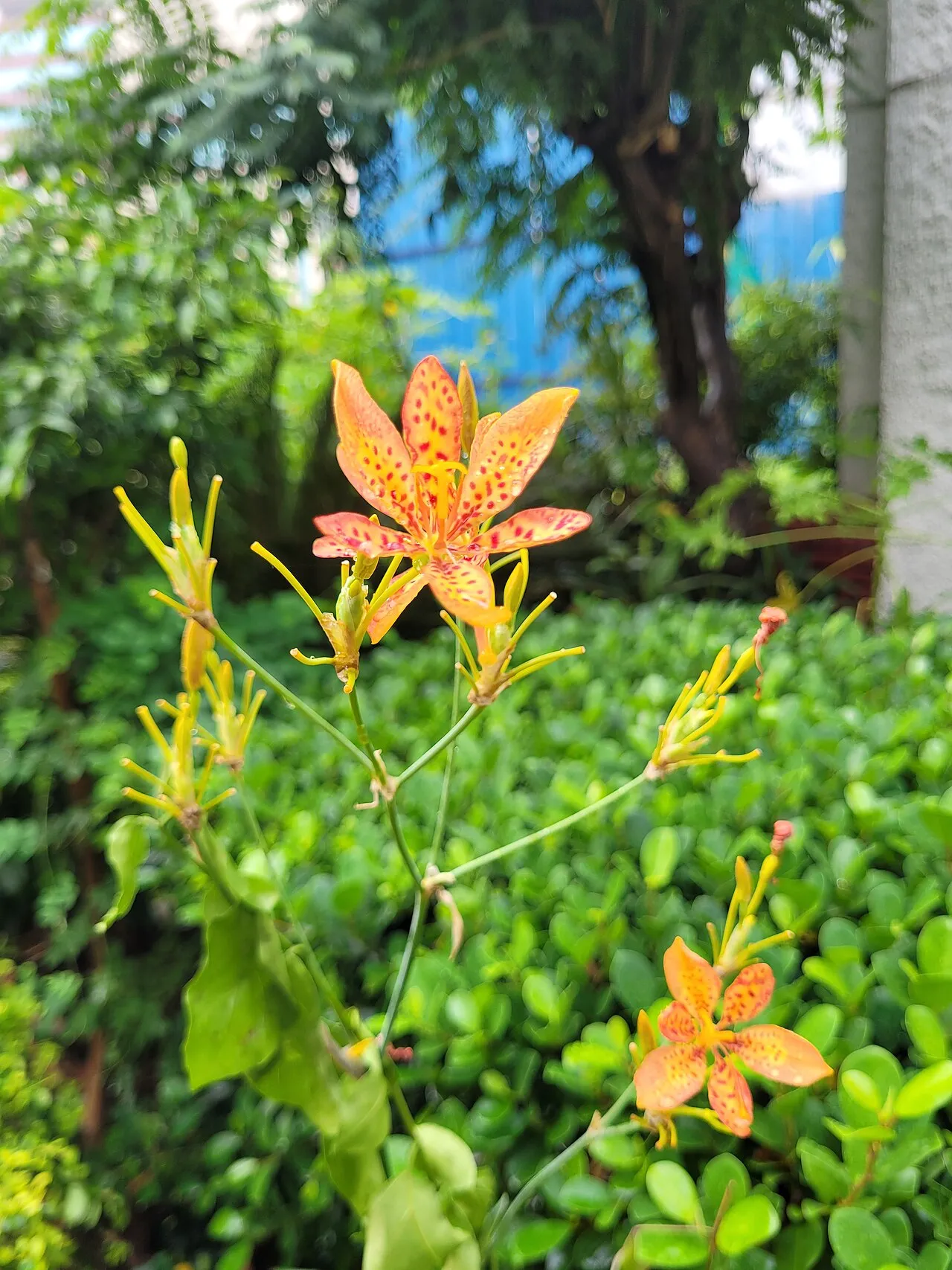
Orange-red flowers at the tops of the stems in summer, July to August. NC State describes the 2-inch flowers as mainly orange with red dots and a tint of yellow at the centre.
Individual flowers are short-lived, but a plant carries many on branching stems and opens them in succession over several weeks. The effect is airy and freckled rather than showy — this is not a plant that dominates a border.
The seed pods are the point
The common name comes from what happens after flowering.
NC State describes the fruit as “yellow-green and lobed capsules” that split to reveal a blackberry-like seed cluster. The capsule peels back in three sections and exposes a tight, glossy, blue-black cluster of seeds that genuinely does look like a blackberry sitting on the end of the stem.
They persist well into autumn and winter, hold their shape when dried, and are excellent in arrangements. For many gardeners they are more valuable than the flowers.
A practical consequence: if you want the seed heads, do not deadhead. If you do not want the plant seeding around, cut the stems before the capsules open — it self-seeds readily.
Conditions
Hardiness: zones 5a to 10b.
Size: 2 to 4 feet tall and 9 inches to 2 feet wide. Upright and narrow, so it fits into gaps that a wider perennial could not.
Light: full sun — six or more hours.
Soil: tolerant of a range of soil types, with good drainage the requirement. Drought tolerant once established, which combined with the full-sun preference makes it a good candidate for a hot dry border where less tough perennials struggle.
As with most rhizomatous irises, the failure mode is wet ground in winter rather than cold.
Problems
NC State reports no serious pest or disease issues overall, but names three worth watching: iris borers, slugs and snails.
Iris borer is the one to take seriously, and it is the reason the iris family connection matters practically rather than just as trivia. The borer tunnels into the rhizome and opens the way for bacterial soft rot. The management is the same as for bearded iris: clear old foliage and debris in autumn, since that is where the eggs overwinter, and cut out and discard any rhizome that is soft, holed or foul-smelling.
Propagation
Division of the rhizomes, or seed — and it comes readily from its own seed, which is how most gardeners end up with more than they planted.
The short version
An iris that is neither a lily nor fruiting, wanting full sun, sharp drainage and little water once established. Grow it for the seed heads as much as the flowers: leave the capsules to split in autumn if you want the blackberries, cut them earlier if you do not want seedlings. Clear the old foliage in autumn to stay ahead of iris borer.
- blackberry lily
- iris domestica
- seed heads
- drought tolerant
- iris borer