Outdoor Plants & Flowers
Why Rose Leaves Turn Yellow
Yellow rose leaves are usually disease, not feeding. How to tell black spot from the handful of other causes.
The Garden Magic Hub
- Zone
- 5–9
- Light
- Full sun
- Water
- Moderate
- Level
- Intermediate
On this page
Look at the pattern before anything else
Yellow rose leaves are common enough that people reach for fertiliser by reflex. Feeding is rarely the answer, and the pattern of yellowing usually identifies the cause in under a minute.
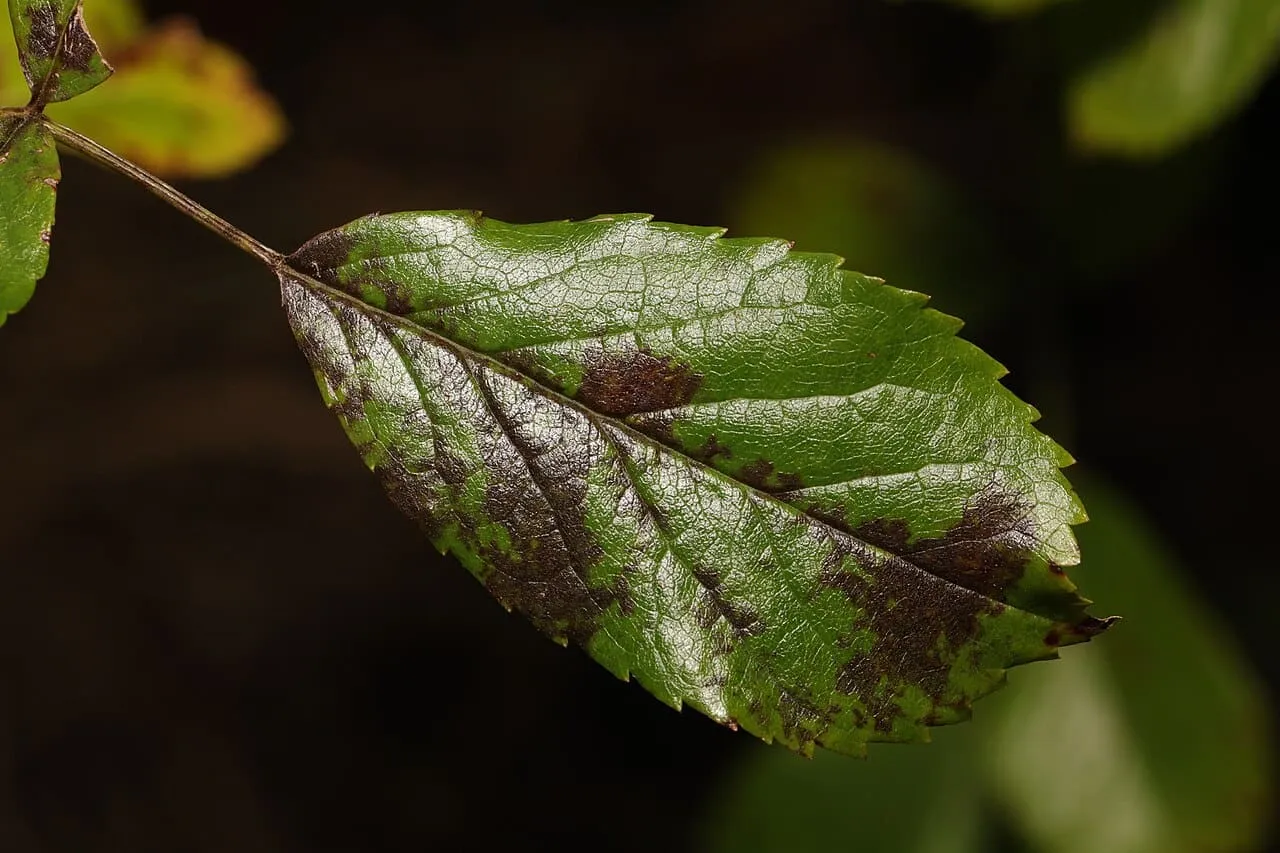
Black spot: yellow with a feathered black lesion
This is the most common cause by a wide margin.
University of Maryland Extension describes it as “feathery-edged, black spots on lower leaves”, after which “the leaves turn yellow and drop off. The disease continues up the stems until the entire plant becomes defoliated.”
How to recognise it: look at a yellow leaf closely before it drops. If it carries dark spots with fuzzy, indistinct margins — often ringed with yellow — that is black spot. The progression runs from the bottom of the plant upward.
If the leaf is uniformly yellow with no lesion at all, keep reading.
Natural leaf drop
Roses shed old lower leaves routinely, particularly after a heavy flush of bloom. One or two yellow leaves low down, on a plant that is otherwise growing and flowering, is normal.
The distinguishing feature is scale. Normal senescence affects the occasional leaf; black spot affects many, in a rising front.
Watering, in both directions
Waterlogging is the more common of the two in roses. Roots in saturated soil cannot take up oxygen, and the plant yellows and drops leaves. Suspect it in heavy clay, after prolonged rain, or where the bed sits low.
Drought stress yellows leaves too, usually with crisping at the margins first and wilting during the day.
Check the soil rather than guessing. Both produce a yellow, unhappy rose, and the treatments are opposite.
Nutrient deficiency
Real, but over-diagnosed. Two patterns are worth knowing apart:
- Uniform yellowing of the oldest leaves first, with new growth still green, suggests nitrogen. Nitrogen is mobile, so the plant moves it out of old tissue into new.
- Yellow between the veins while the veins stay green suggests iron or magnesium. On roses this is frequently a pH problem rather than a shortage — iron becomes unavailable in alkaline soil even when plenty is present.
Test the soil before adding anything. Feeding a rose that is yellowing from black spot or wet feet achieves nothing.
The less common causes
Spider mites, in hot dry weather. Fine pale stippling that coalesces into a bronzed, dusty look, with fine webbing on leaf undersides in advanced cases.
Sudden shade. A rose gradually overgrown by a neighbouring shrub will thin and yellow from the bottom.
Rose rosette disease, which produces distorted, excessively thorny red new growth rather than simple yellowing — but is worth ruling out because infected plants must be removed.
Herbicide drift, which distorts new growth rather than yellowing old.
The order to work through
- Examine a yellow leaf for feathered black lesions → black spot.
- Check soil moisture → waterlogging or drought.
- Note which leaves and whether veins are spared → nutrient pattern.
- Check leaf undersides for stippling and webbing → mites.
- Only then consider feeding, and only after a soil test.
- roses
- yellow leaves
- diagnosis
- black spot