Outdoor Plants & Flowers
How to Lift and Store Dahlia Tubers
Most tubers are lost to rot or shrivelling in storage, not to cold in the ground. The drying time and temperature that decide it.
The Garden Magic Hub
- Zone
- 8–11
- Light
- Full sun
- Water
- Moderate
- Level
- Intermediate
On this page
Where storage actually goes wrong
Dahlias are hardy in roughly zone 8 and warmer. Below that, tubers are lifted and stored — and most of the ones that are lost are lost in storage rather than in the ground.
Two failure modes account for nearly all of it. Tubers rot, because they went into storage damp or were stored too warm. Or they shrivel, because the air was too dry or the temperature too high.
Everything below is about staying between those two.
When to lift
You do not have to wait for frost. Penn State Extension notes it is “unnecessary to wait for the first frost to dig up tubers,” though waiting means you get every last bloom — in zone 5b that lands around the second or third week of October.
After the first frost blackens the foliage is the traditional signal, and it works.
Remember the 120-day rule from planting: tubers need a full season in the ground to be worth storing.
Lifting and drying
Cut the stalks down first, to a height you can handle. Penn State’s approach is to cut “the stalk down to where I can carry the clump.”
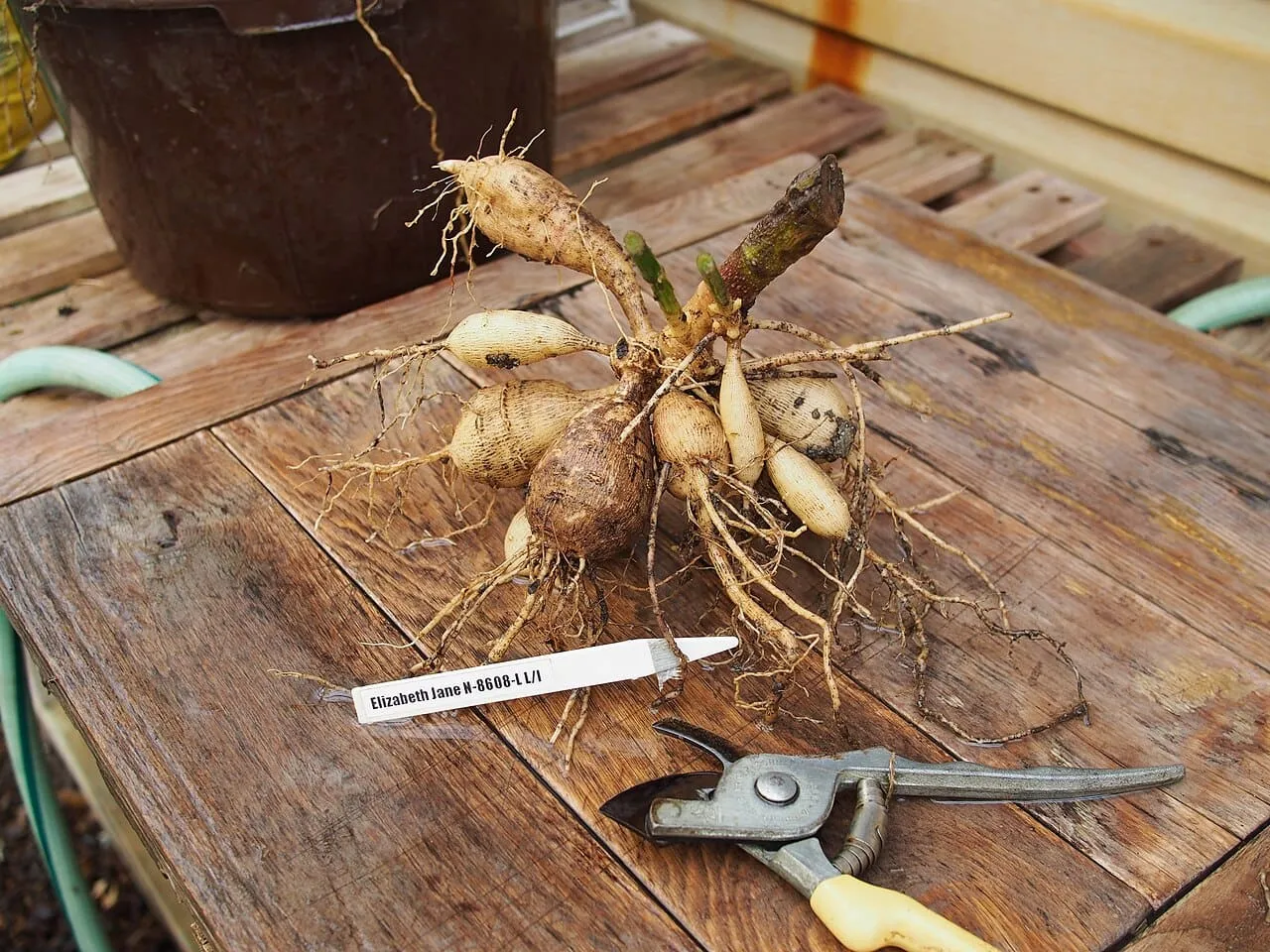
Lift carefully and widely. Dig well outside the clump — tubers extend further than you expect, and a spade through the neck ruins that tuber. The neck, where tuber joins stem, is the fragile part and a broken neck means the tuber will not grow.
Remove soil, gently. Wisconsin Horticulture advises to dry carefully and do not wash. Penn State does hose the clumps off. Both work; the important thing is that whatever moisture you add must be dried off completely before storage.
Then dry them properly, and give it longer than you think. The commonly quoted figure is 24 to 48 hours. Penn State found that insufficient: “I originally let them dry for the recommended 24-48 hours, but I found that they needed more time to dry, or they were more prone to rot” — settling on four or five days out of the sun.
That single adjustment prevents most storage rot.
Storage conditions
Temperature is the critical variable. Wisconsin gives 35 to 45°F; Penn State’s storage area runs 40 to 50°F. The working range is roughly 40–50°F: cold enough to keep them dormant, above freezing.
Too warm and they sprout or shrivel. Freezing kills them outright.
Pack them in a medium. Vermiculite, dry sand, peat, or wood shavings — Penn State layers tubers in cedar shavings. The medium buffers humidity and stops tubers touching, so one rotting tuber does not take the others with it.
Do not seal the container. Penn State is specific: “do not click the lid shut.” Sealed containers trap moisture and cause rot.
Keep them out of drafts and away from both damp and very dry conditions.
Check through the winter
This is the step people skip, and it is the difference between losing one tuber and losing the box.
Look at them every few weeks. Penn State: “After a few weeks, I check, and if the shavings are moist to the touch, I change them.”
- Anything soft or mouldy — remove it immediately.
- Shavings damp — replace them.
- Tubers shrivelling badly — the air is too dry or too warm. Very lightly moisten the medium, or move somewhere cooler.
When to divide
Penn State divides in autumn, noting clumps are “more manageable to cut in the fall, but the eyes are more visible in the spring.”
That trade-off is the whole argument. Most guidance favours spring, because cut surfaces going into months of storage are a rot risk and the eyes you are cutting toward are much easier to see once they begin to swell.
If you are new to it, store the clumps whole and divide at planting.
- dahlias
- tubers
- overwintering
- storage