Outdoor Plants & Flowers
The Types of Dahlias, by Form and Size
The classification runs to 29 forms and ten size classes. What the categories mean, and which suit a garden or a vase.
The Garden Magic Hub
- Zone
- 8–11
- Light
- Full sun
- Water
- Moderate
- Level
- Beginner
On this page
Two axes: form and size
Dahlia classification looks intimidating because it describes two things at once. The American Dahlia Society recognises 29 groups based on flower shape, and separately assigns each bloom a size class.
A catalogue entry like “informal decorative, B” is telling you the petal arrangement and the bloom diameter. Once you can read both, choosing becomes straightforward.
The forms worth knowing
You do not need all 29. These cover most of what is sold.
Single — one row of ray florets around an open central disc. Simple, and the best of the group for pollinators, since the centre is accessible.
Collarette — a single outer row plus a shorter “collar” of florets around the disc, usually in a contrasting colour.
Anemone — an outer row of flat florets surrounding a dense pincushion of tubular ones.
Waterlily — fully double and symmetrical, and flat or saucer-shaped from the side. ADS describes the ray florets as “openly faced giving the bloom a delicate appearance,” with a closed dome centre breaking to four to seven rows of broad, slightly cupped outer florets. Widely considered the best form for cutting.
Decorative — fully double with no visible disc, split into formal (evenly arranged, regularly spaced florets) and informal (twisted or irregularly placed florets, a looser look).
Ball — ADS: “ball-shaped with uniform florets, and reflexing toward the stem, completely filling the floral head without notches/points.” Dense, geometric, and long-lasting in a vase.
Pompon — like a ball but smaller and more globular, with florets rolled (involute) for their whole length. The tightest, most formal shape in the genus.
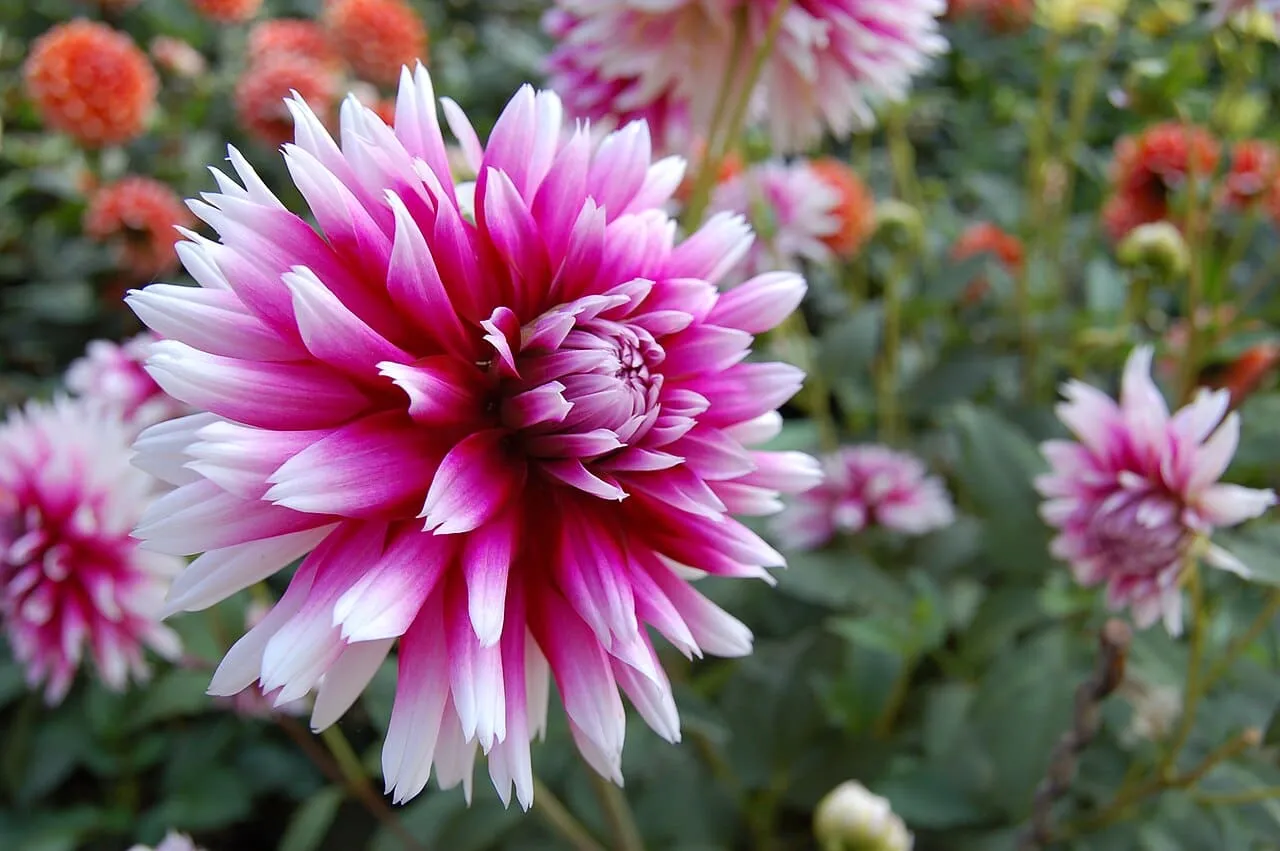
Cactus and semi-cactus — fully double with narrow, pointed, rolled florets giving a spiky, starburst look. Incurved cactus curves the florets toward the centre; laciniated forms have split, fringed tips.
Stellar — fully double with florets curving toward the stem, producing a narrower, more star-like bloom.
The size classes
This is where a lot of disappointment originates — “dinnerplate” is a marketing word, not a class. The ADS scale is precise:
| Class | Code | Bloom diameter |
|---|---|---|
| Giant | AA | over 10 inches |
| Large | A | over 8 to 10 inches |
| Medium | B | over 6 to 8 inches |
| Small | BB | over 4 to 6 inches |
| Miniature | M | up to 4 inches |
| Ball | BA | over 3.5 inches |
| Miniature Ball | MB | over 2 to 3.5 inches |
| Pompon | P | up to 2 inches |
| Mignon Single | MS | up to 2 inches |
| Single | S | over 2 inches |
A giant AA bloom is genuinely over ten inches across — impressive, heavy, and needing serious staking. Those plants also produce far fewer flowers than a small-flowered cultivar.
Choosing by what you want
For cutting: waterlily, ball and small decorative forms in the BB to B range. They hold their shape, last well in water, and the plants produce freely.
For a border: miniature and small forms flower far more prolifically and stand up without heavy staking.
For pollinators: single, collarette and anemone forms. Fully double dahlias have had their reproductive parts bred into petals — a border of decoratives is close to useless to bees.
For the spectacle: giant and large decoratives. Accept fewer blooms, sturdy stakes, and a plant that needs disbudding to reach full size.
For containers: miniature and mignon types, and the dwarf bedding dahlias sold as seed.
One practical note
Bloom size is partly under your control. Removing the two side buds beside each terminal bud — disbudding — concentrates the plant’s resources and produces noticeably larger flowers on longer stems.
Leave them on and you get more, smaller blooms. Neither is wrong; it depends whether you are filling a border or a vase.
- dahlias
- classification
- flower form
- cut flowers