Outdoor Plants & Flowers
When and How to Plant Dahlia Tubers
Depth, timing and orientation decide whether a tuber rots or sprouts. What to do, and why dividing waits until spring.
The Garden Magic Hub
- Zone
- 8–11
- Light
- Full sun
- Water
- Moderate
- Level
- Beginner
On this page
Wait for the soil, not the calendar
Dahlia tubers are planted in spring after the danger of frost has passed. They are frost-tender, and a tuber planted into cold wet soil is far more likely to rot than to sprout.
Soil temperature matters more than the date. A tuber sitting in cold ground does nothing but decay slowly; the same tuber planted two weeks later into warmed soil frequently overtakes it.
If you want an earlier start, pot tubers up under cover a few weeks before your last frost date and plant out the growing plants once frost risk has passed.
One timing constraint worth planning around
If you intend to lift and store the tubers at the end of the season, there is a minimum.
Dahlias need to be in the ground for at least 120 days to produce tubers mature enough to store. Planted too late, you get flowers but not tubers worth keeping.
Count back from your first frost date. If the gap is under 120 days, start them under cover.
Depth and orientation
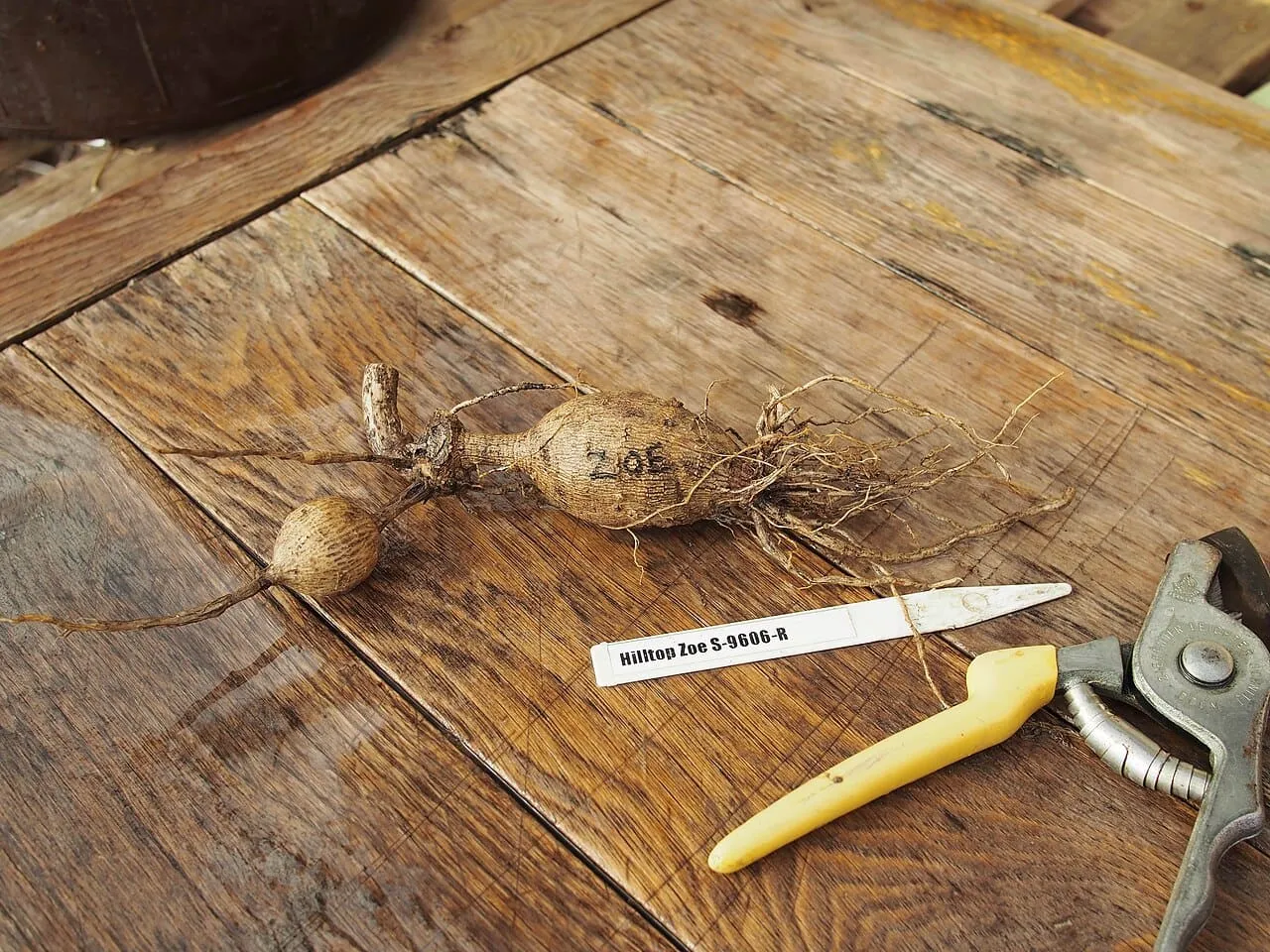
Plant tubers four to six inches deep, with the eyes facing upwards, then cover with soil to ground level.
The eye is the growth bud, and it sits where the tuber joins the stem of last year’s growth — not on the pointed root end. It looks like a small pink or white pimple, and on a dormant tuber it can be very hard to see.
A tuber with no eye will never grow. It has no growth point, and no amount of care substitutes. If you are buying tubers, buy ones where you can find the eye.
Lay tubers roughly horizontal with the eye uppermost rather than standing them on end.
Divide now, not in autumn
This is the point that catches people out, and the sources agree on it.
Dahlia tuberous roots should not be divided before going into storage in autumn — they should be divided at planting time in spring.
Two reasons. First, dividing creates wounds, and wounds on a tuber going into months of storage are an invitation to rot. Second, the eyes are far more visible in spring, when they have begun to swell, than on a freshly lifted clump in October.
When you do divide, cut the clump into sections with a sharp knife, making sure each piece has at least one eye. A section of tuber without an eye is dead weight.
Siting and support
Full sun, and soil that drains. Dahlias are heavy feeders and thirsty in summer, but they will not tolerate sitting wet — particularly early in the season before top growth is established.
Put stakes in at planting time for tall cultivars. Driving a stake in later, once the clump has developed, spears the tubers.
Do not water them in
One counterintuitive point specific to dahlias. A newly planted tuber has no roots and no leaves, so it cannot use water — and wet soil around a dormant tuber is the main cause of rot.
Plant into soil that is already reasonably moist, then leave it alone until shoots appear above ground. Start watering properly once there is a plant to water.
- dahlias
- tubers
- planting
- spring