Fungal Disease
Powdery Mildew — How to Identify, Treat, and Prevent It
The white dust on your squash and phlox leaves is powdery mildew. It spreads in dry weather, not wet, and that one fact changes how you should handle it.
The Garden Magic Hub
- Level
- Beginner
- Season
- Summer, Fall
On this page
Powdery mildew is the disease most gardeners can identify on sight and most still manage badly, because nearly everything people assume about it is backwards.
Identifying it
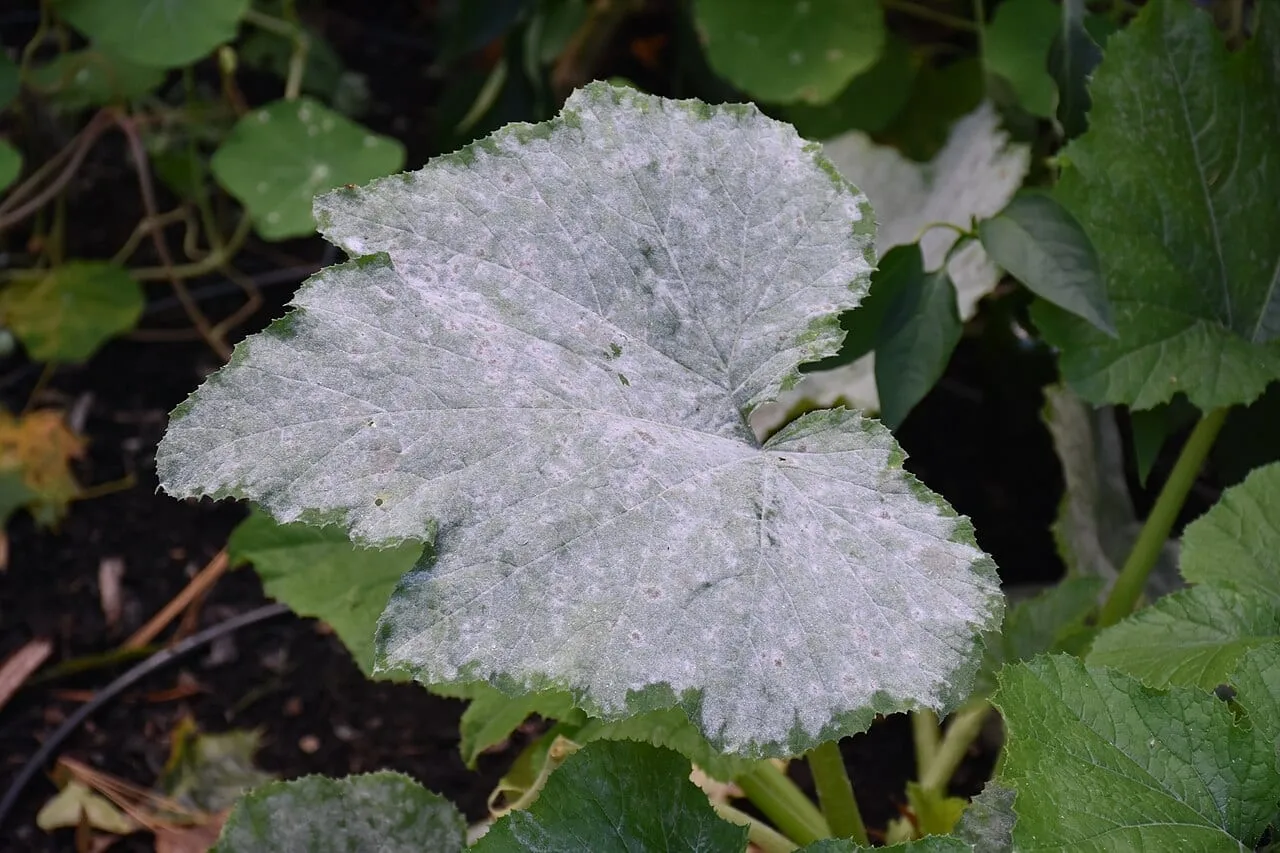
Look for white to pale grey patches on the upper surface of leaves — small circular spots that spread and merge until the leaf looks dusted with flour. The growth sits on top of the leaf, and you can rub it off with a finger.
That rub test is the fastest way to separate it from the two diseases it gets confused with. Downy mildew produces fuzzy grey growth on the leaf underside, with angular yellow patches above it, bounded by the leaf veins. Fungal leaf spot produces defined lesions with distinct margins that do not wipe away.
Badly affected leaves yellow, curl at the edges, and drop early. On squash and cucumbers this can cut a harvest short by exposing fruit to sunscald.
The part that surprises people
Most fungal diseases need water sitting on a leaf to germinate. Powdery mildew does not. Its spores germinate on a dry leaf surface, and free water actually suppresses them.
What it wants is humid air, moderate temperatures around 60–80°F, shade, and stillness. That is why it shows up in a humid August, on the crowded shaded side of a plant, and worst where airflow is poorest.
This has a practical consequence: overhead watering does not cause powdery mildew and can even wash spores off. It encourages plenty of other diseases, so this is no reason to start — just a reason to stop blaming it for this one.
It is not one fungus
Powdery mildew is a name for several hundred related fungal species, and most are narrowly host-specific. The species on your bee balm cannot infect your cucumbers. The species on your lilac cannot move to your roses.
So when it appears on a second plant across the garden, that is not spread — it is two separate infections finding the same conditions. Ripping out plant A will not protect plant B.
Prevention, which is where the real gains are
- Space plants properly. Follow the spacing on the tag even when the seedlings look absurdly far apart. Airflow through a planting is the single strongest lever you have.
- Thin dense interiors. Removing a few crowded stems from the middle of a phlox clump or a squash plant does more than any spray.
- Choose resistant cultivars. Powdery mildew resistance is well developed in cucumbers, squash, zinnias, phlox, and bee balm. Look for it on the seed packet.
- Go easy on nitrogen. Heavy feeding pushes soft, thin-walled new growth that is markedly more susceptible.
- Site for morning sun. Sun burns off overnight humidity early.
Treating an active infection
Remove the worst leaves and bag them for the trash, not the compost pile — unless yours reliably gets hot.
For sprays, potassium bicarbonate is the most effective widely available organic option and works on contact, so thorough coverage of both leaf surfaces matters more than the product. Horticultural oil and neem oil also work, and additionally suppress overwintering spores. Sulfur is effective but must not be applied within two weeks of an oil spray, or above about 90°F, where it will burn foliage.
Milk sprays are widely repeated online; the evidence is thin and the effect modest.
One last judgement call: on squash, lilac, and bee balm, mildew arriving in late summer is largely cosmetic — the plant has already done its work. Cut it back, clear the debris, and spend the effort on spacing next spring.
- powdery mildew
- fungal disease
- air circulation
- organic control