Pests, Diseases & Problems
How to Identify and Treat Scale Insects
Scale looks like brown bumps, not an insect, which is why it spreads unnoticed. How to identify it, and why timing decides if treatment works.
The Garden Magic Hub
- Level
- Advanced
On this page
Why it does not look like a pest
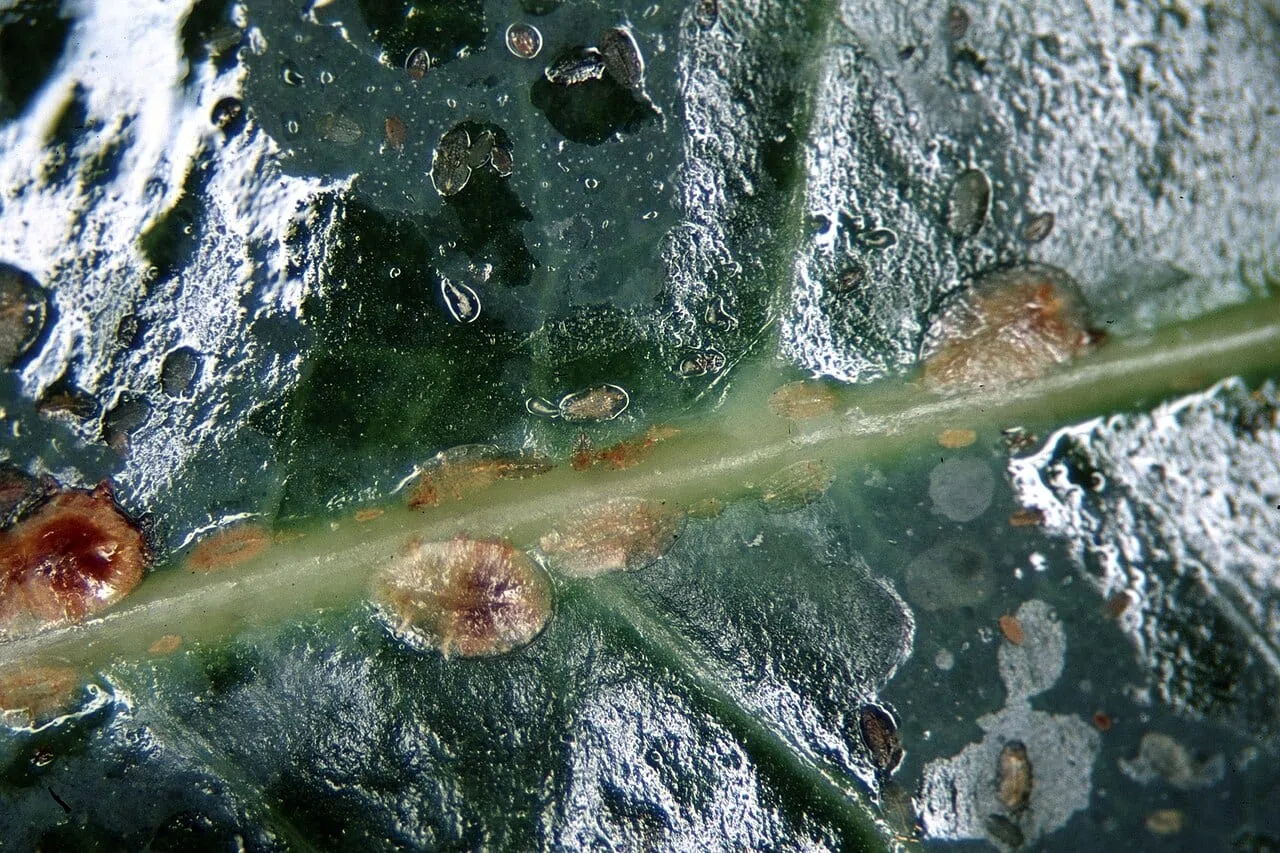
Scale insects do not read as animals. Clemson HGIC describes adults as “small and immobile with no visible legs,” from “1/16– to ½-inch in diameter,” with some looking “flat and appear like fish scales stuck to a plant” and others like “waxy, colored masses.”
Nothing about that says insect. People notice brown bumps on a stem, assume they are corky growth or part of the plant, and leave them for months.
The check takes a second: try to scrape one off with a fingernail. Plant tissue does not detach. Scale does.
Soft or armoured — the branch that matters
This distinction decides what treatment can work at all.
Clemson’s definition is precise. An armoured scale “secretes a waxy covering that is not an integral part of its body. The covering can be scraped off to locate the insect.” A soft scale’s waxy covering “is an integral part of its body.”
There is a shortcut. Soft scales excrete honeydew and armoured scales do not. If the leaves below the bumps are sticky, or a black sooty film is forming on them, you have soft scale. No stickiness at all points at armoured — which is the harder of the two.
Where to check
Clemson puts them “usually found on stems and the undersides of leaves but may be found on upper surfaces as well.” Run a finger along stems and leaf midribs, especially where a leaf joins the stem. Scale concentrates along the sap routes.
The crawler stage is the whole game
Scale is only mobile when young. Clemson notes the immature forms “are called crawlers, are mobile, and they also feed by sucking plant sap.”
That mobile stage is also the vulnerable one. Once an insect settles and builds its covering, it is physically shielded from contact sprays — Clemson notes adult scales are “resistant to many insecticides due to waxy covering,” and that oils work chiefly by “smothering” rather than by poisoning.
This is why scale defeats people. A spray that would kill an aphid outright bounces off an adult scale, and the reader concludes the product was fake.
What actually works
Scrape first. Clemson recommends removing early infestations by scraping with a fingernail. On a plant with a manageable number of bumps this is the most effective single action available to you, because it removes insects that no spray will reach.
Then oil. Neem or canola oil, applied to cover thoroughly, works by smothering, which is the one mechanism that gets past the waxy covering. Insecticidal soap is effective against crawlers.
Then repeat. Because crawlers emerge over time rather than all at once, one application catches one cohort. Expect several rounds spaced a week apart, and keep inspecting for a month after you think it is over.
Be willing to give up
Armoured scale on a mature woody houseplant is genuinely difficult to eradicate at home, and a plant you cannot clear is a reservoir infecting everything near it. Discarding it is a legitimate outcome, not a failure — and it is advice most houseplant guides will not give you.
- scale insects
- houseplant pests
- identification
- horticultural oil