Pests, Diseases & Problems
How to Identify and Treat Spider Mites
Spider mites are almost invisible until the webbing shows. How to confirm them early, and why most people stop treating far too soon.
The Garden Magic Hub
- Level
- Intermediate
On this page
The damage shows before the mite does
You will see the feeding injury long before you see the animal. UC IPM describes it as “light-colored spots or specks, called ‘stipples’ or ‘stippling’ damage, on leaves.” Held to the light, an affected leaf looks finely peppered, and across a whole plant it reads as a dusty or bronzed cast rather than as damage.
Webbing comes later. By the time you can see silk strung between leaves and stems, the population has been building for weeks.
Severe infestations, UC IPM notes, “cause leaves to dry and fall from the plants.”
Confirming it
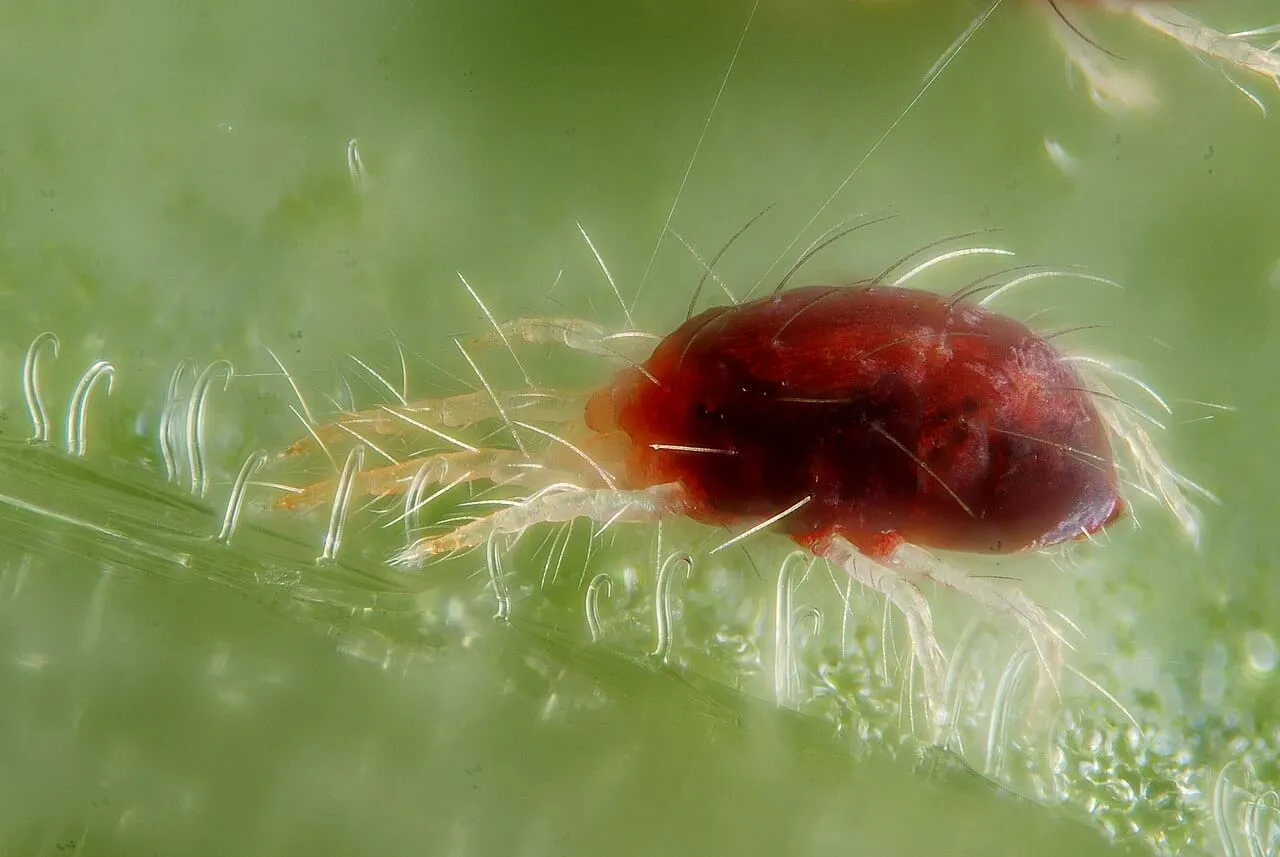
The mites themselves are about 0.5 mm — UC IPM gives “about 0.02 inch long” — and live mostly on leaf undersides. A 10x hand lens settles the question in seconds and is the single most useful tool for this pest.
Without one, hold a sheet of white paper under a leaf and tap it sharply. Moving specks that were not there before are mites.
Spider mites or thrips?
Both scar the leaf surface and both are easy to miss. The debris tells them apart: thrips leave tiny black frass specks alongside the silvering, and their damage concentrates in new growth and flower buds. Spider mites leave no frass, and produce webbing that thrips never do.
Why they appeared now
Spider mites do well in warm, dry, still air — which describes most heated homes in winter and most rooms near a radiator year-round. Dust on foliage makes it worse, and UC IPM lists reducing dust among its control measures.
Treating: wash first
Start physically. Take the plant to a sink or shower and wash both leaf surfaces, paying attention to the undersides. UC IPM recommends washing leaf surfaces frequently with water and removing infested plant parts before reaching for anything else. This knocks the population down and puts the survivors somewhere a spray can reach.
Then use insecticidal soap or horticultural oil, covering the undersides thoroughly. Cover is not optional — these are contact products.
The interval is what decides it
This is where most treatment fails, and it is arithmetic rather than product choice.
Insecticidal soap has no residual action. Clemson HGIC is explicit that once the solution dries it has no further effect, and that repeat applications are needed “at relatively short intervals (four to seven days)” for pests including spider mites — noting it is “often necessary to spray once a week for several weeks to control mites.”
The reason is the lifecycle. At 75°F, UC IPM puts development from egg to adult at about two weeks. Eggs are not killed by a contact spray, so a single application removes the visible generation and leaves the next one intact. Treat once and you will see them again in a fortnight and conclude the product failed.
Plan on three or four applications, four to seven days apart, and keep going for a week after you stop seeing damage.
When to stop trying
UC IPM includes discarding heavily infested plants among its recommendations, and it is sound advice that almost no houseplant guide will give you. A badly infested plant next to a healthy collection is a reservoir. If it is common, cheap and covered in webbing, the collection is worth more than the plant.
- spider mites
- houseplant pests
- webbing
- humidity