Pests, Diseases & Problems
How to Identify and Treat Thrips
Thrips leave silvery streaks and black specks before you ever see the insect. How to confirm them, and why they are the hardest indoor pest to clear.
The Garden Magic Hub
- Level
- Advanced
On this page
The damage arrives first
You will diagnose thrips from what they leave behind, not from seeing them. Clemson HGIC describes both adults and nymphs feeding “by scraping surface cells to suck plant sap,” which produces leaves with “a silvery or speckled appearance,” early leaf drop, and flower buds that “may die without opening.”
That silvering is the tell. Where a spider mite leaves pinpoint stippling, thrips scrape in streaks, and the damaged tissue takes on a metallic, washed-out look.
Finding the insect
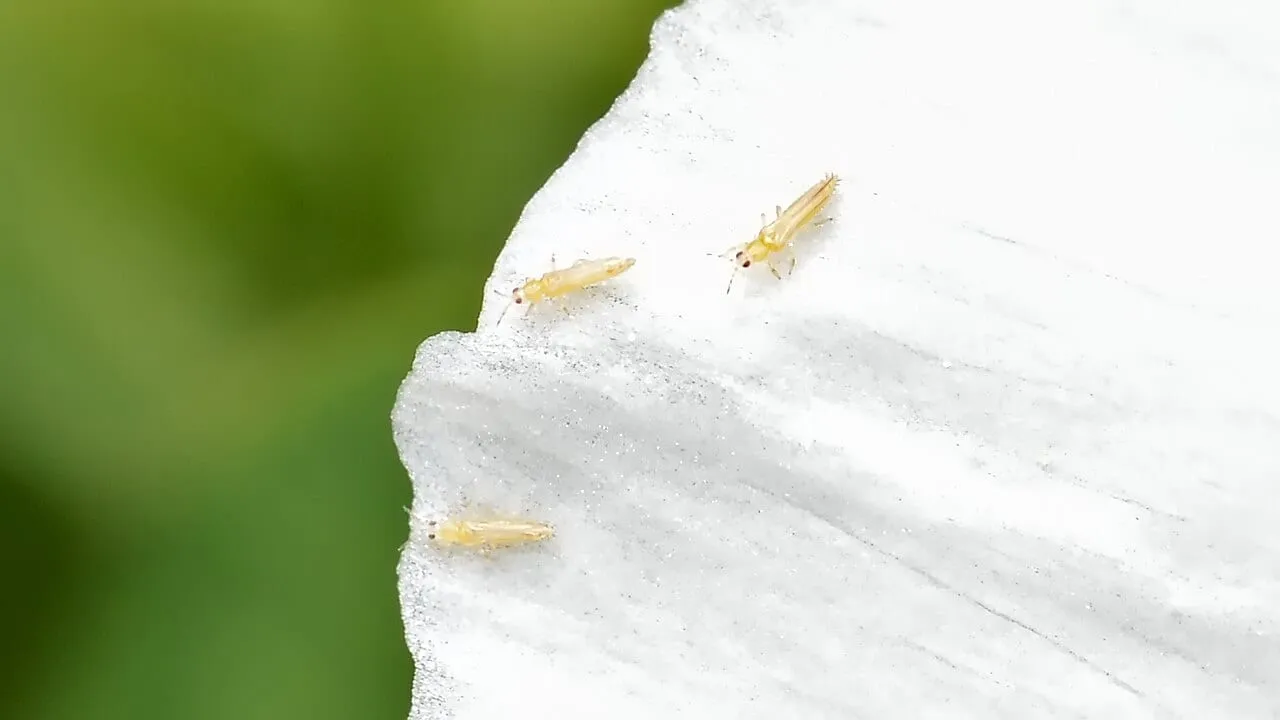
Thrips are small enough to be genuinely hard to see. Clemson puts them at “less than 1/16 inch in length,” describing “tiny, slender, yellowish to blackish insects with fringed wings,” and notes they are “very difficult to see without a magnifying lens.”
There is a better method than squinting. Clemson’s suggestion: “Blowing lightly into blooms and leaves causes thrips to move around quickly.” A puff of breath into a flower or a tight cluster of new growth will send them scattering, and movement is far easier to catch than shape.
Look where they hide, which Clemson gives as “on leaves and between flower petals.”
Thrips or spider mites?
Both scar leaf surfaces, and confusing them wastes weeks.
Thrips leave tiny black frass specks alongside the silvering, and concentrate their damage in new growth and flower buds. Spider mites leave no frass but do produce fine webbing, and their damage reads as even stippling rather than streaks.
If you see webbing, it is mites. If you see black specks, it is thrips.
Why they are the hardest one
Thrips spend part of their life cycle where your spray is not. They shelter inside unopened buds and tight new growth, and several life stages are hidden at any given moment.
The consequence is that a single treatment reaches only the exposed fraction. Combined with the contact-only nature of soap — Clemson notes that once the solution dries it has no residual effect, and recommends repeats at four to seven day intervals — one round is close to pointless.
Assume weeks, not days.
Treating them
Rinse first. Clemson’s first listed control is rinsing leaves with water. This removes a real fraction of the population and costs nothing.
Then soap, thoroughly and repeatedly. Cover both leaf surfaces and get into the growing tips. Four to seven day intervals, at least three or four rounds, continuing past the point where you stop seeing new damage.
Buds are the exception. For infestations inside flower buds, Clemson advises systemic insecticides — spinosad, acetamiprid or imidacloprid — precisely because contact sprays cannot reach inside a closed bud. Soil-applied imidacloprid granules are also listed. Read the label and confirm indoor use before reaching for these.
Knowing when to stop
Thrips are the pest most likely to defeat a careful home grower, and it is worth saying so plainly. If a plant has been treated properly for a month and new growth still emerges scarred, discarding it protects everything nearby. That is a reasonable decision, not a failure of effort.
- thrips
- houseplant pests
- leaf damage
- treatment