Vegetable & Fruit Gardening
Why Cucumber Leaves Turn Yellow
Yellow cucumber leaves point to a pest or one of two mildews. How to narrow it down by the pattern and which leaves went first.
The Garden Magic Hub
- Light
- Full sun
- Water
- High
- Level
- Beginner
- Season
- Summer
On this page
Read the pattern, not the colour
“Yellow” is not a diagnosis on a cucumber. The University of Maryland Extension’s key to cucumber problems separates the causes by the shape of the yellowing and which leaves it started on — and those two observations get you most of the way.
Look closely at one affected leaf before you do anything else.
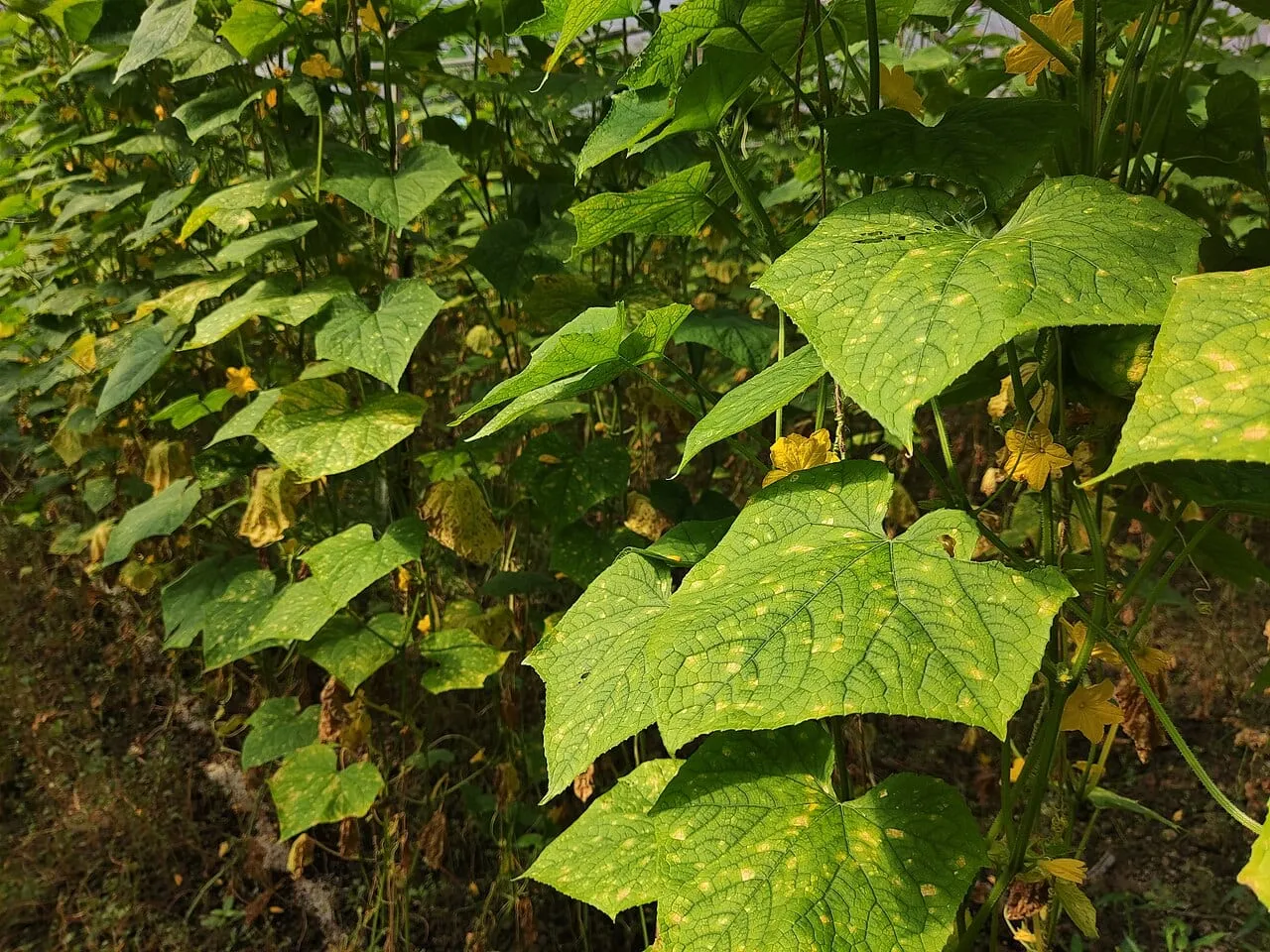
Angular yellow patches, bounded by veins
Downy mildew. Maryland describes “yellow or tan angular spots between the leaf veins,” visible on the upper surface of older leaves, appearing in early to late summer.
The angularity is the signature. The patches look as though they have been drawn with a ruler, because the leaf veins physically stop the pathogen spreading past them. Nothing else on this list produces straight edges.
Turn the leaf over in humid weather and you may find greyish fuzz on the underside beneath the yellow patch.
Fine speckling that merges into patches
Spider mites. Maryland notes “fine yellow or white spots (stippling)” that “may coalesce to form yellow patches on the upper side,” with undersides that “may appear dirty.”
That dirty look is dust, cast skins and webbing. Confirm by holding white paper under a leaf and tapping it — moving specks are mites. Spider mites thrive in hot, dry weather, so they tend to arrive in the same conditions that stress the plant anyway.
Squash bugs produce something similar: Maryland lists “small yellow-green or white spots on leaves (stippling),” with leaves that “may eventually appear tattered, yellow.” The difference is that squash bugs are large enough to see — check leaf undersides and the base of the plant for grey-brown insects and bronze egg clusters.
White powder first, yellowing after
Powdery mildew. Maryland puts it starting mid-summer on older leaves, with “white powdery growth” leading to leaves that “wither and die.”
Here the yellowing is secondary — the white coating comes first. If you saw powder before you saw yellow, this is your answer, and it is usually a late-season problem you can live with.
Mottled yellow-and-green
Virus. Maryland describes a “yellow or green mosaic pattern or mottling of the leaves.”
Mosaic means irregular light and dark patches with soft boundaries, often with distorted or stunted new growth. There is no treatment; remove affected plants and control the aphids and beetles that spread the viruses.
What this key does not cover
Worth saying plainly: the Maryland key does not address nutrient deficiency or watering as causes of cucumber yellowing.
That does not mean they never happen — a uniformly pale plant in poor soil is a real thing, and nitrogen is mobile enough that older leaves fade first. But it does mean that if you are reaching for fertiliser because the leaves are yellow, you are reaching for the option the extension key does not list, while four documented causes have distinctive patterns you can check for in about thirty seconds.
Check the pattern first.
- cucumber
- yellow leaves
- downy mildew
- diagnosis