Root Vegetables
How to Grow and Care for Carrots
Forked carrots and patchy germination are both settled before you sow. Here is how to prepare the bed, stop the soil crusting, and thin at the right moment.
The Garden Magic Hub
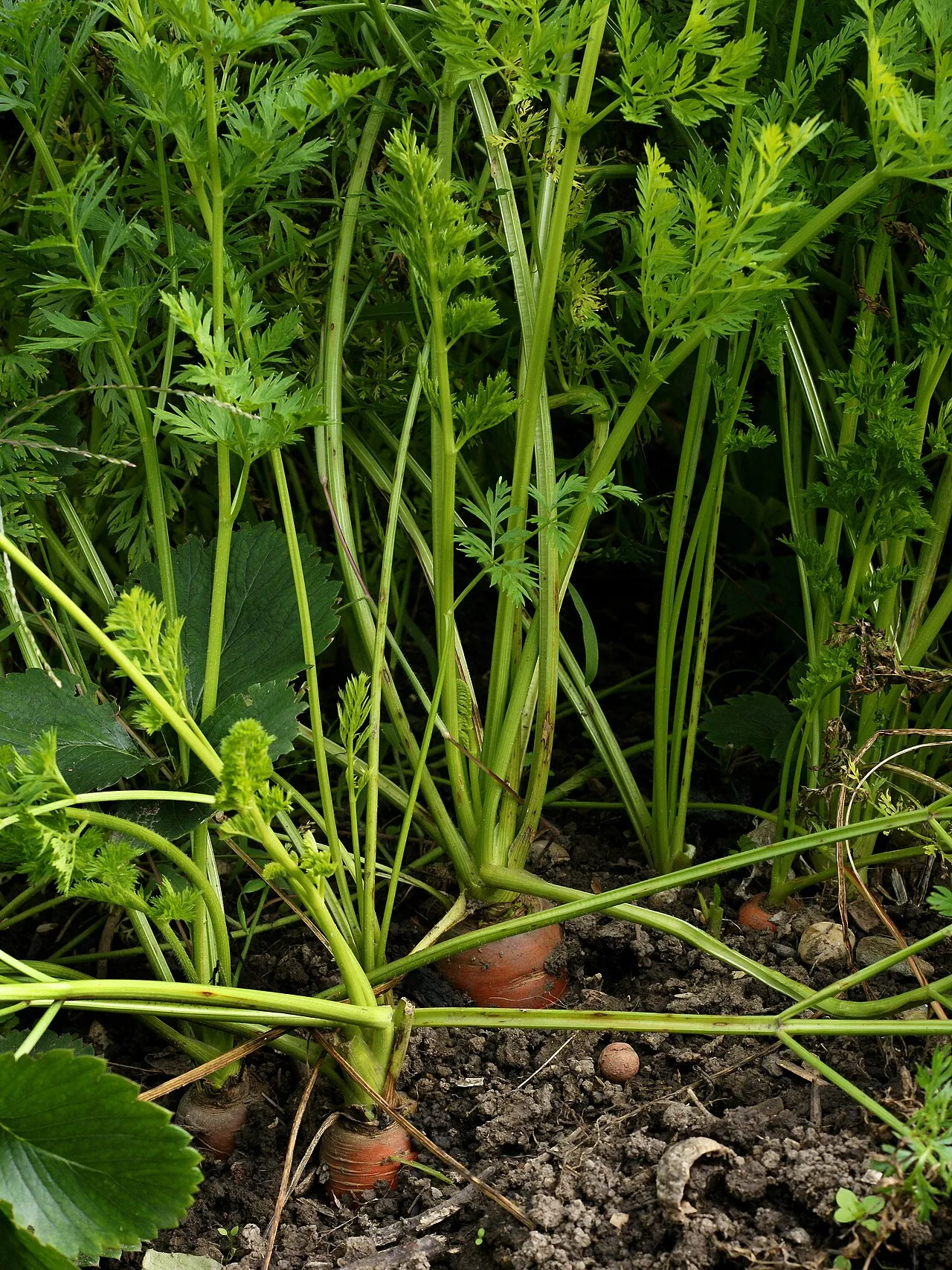
- Zone
- 3–10 (grown as an annual)
- Light
- Full sun
- Water
- Moderate
- Level
- Intermediate
- Season
- Spring, Fall
On this page
Carrots have two classic failures — roots that fork and split into useless fingers, and rows that come up half empty. Both are decided in the week before you sow, not during the season.
Forking is a soil problem
Clemson HGIC is specific about what carrots need: “a good-textured, loamy or sandy soil that is free of stones and clods.” Heavy clay causes poor root growth and forking.
The mechanism is simple. A carrot is a single taproot pushing straight down. When the tip meets a stone, a hard clod, or a pocket of undecomposed material, it divides and goes around — and a divided root never rejoins.
So bed preparation is the whole job:
- Dig deeply and remove stones. Not most of them — the one you leave is the one a carrot finds.
- Break up clods to a fine tilth, at least as deep as the variety’s mature length.
- Do not add fresh manure before a carrot crop. It encourages forking and hairy roots, and carrots are one of the few crops where poor, well-worked soil beats rich, recently amended soil.
- If your soil is heavy, either build a raised bed with sandy loam, or grow short, stump-rooted varieties — ‘Chantenay’, ‘Paris Market’ and similar are bred for exactly this problem.
Germination is the other half
Carrot seed is tiny, sown shallow, and slow to come up — a fortnight or more. In that time the soil surface can dry and form a crust the seedlings cannot break through, which is the usual cause of a patchy row.
Clemson’s sowing method addresses it directly. Sow at roughly a quarter-inch between seeds, then cover only ⅛ inch deep — with sawdust, vermiculite, or manufactured potting soil rather than garden soil.
That substitution is the trick worth stealing. Those materials do not crust, they stay looser as they dry, and the seedlings push through easily.
Temperature matters too. The optimal soil range is 55–75°F, and seed will not germinate above 95°F. That rules out midsummer sowing in hot regions — carrots are a spring and autumn crop there.
Keep the surface consistently damp until the seedlings appear. A board or damp burlap laid over the row helps, but it must come off the day germination starts.
Thin, and thin on time
Thin to 2 to 3 inches between plants when the seedlings are 1 to 2 inches tall. Rows go 12 to 18 inches apart.
Do it at that stage. Left crowded, carrots compete and stay thin, and by the time you notice, pulling one disturbs its neighbours. Snip the surplus at soil level with scissors rather than pulling.
Carrot thinnings have a strong scent that attracts carrot rust fly, so clear them away rather than leaving them on the bed, and thin in the evening if the pest is a problem locally.
Watering — and why it changes the flavour
Uniform moisture is the requirement, and Clemson names the consequences of getting it wrong: irregular watering causes “cracks, strong flavor, and coarseness in the roots.”
That is a more interesting failure than most. An erratically watered carrot is not just misshapen — it genuinely tastes worse and has a coarser texture.
Water to moisten the soil to a depth of 6 inches, and mulch once the seedlings are established to buffer the swings.
Harvest and storage
About 65 to 75 days after planting, or whenever they reach the size you want — carrots are usable well before full maturity, and small ones are sweeter.
Loosen the soil beside the row with a fork before pulling. Yanking a carrot out of firm ground snaps it.
For storage, Clemson gives 33°F and high humidity. Carrots left in a bunch with tops on keep 10 to 14 days; topped carrots keep 4 to 6 months. Cutting the tops off immediately is the single biggest factor — the foliage keeps drawing moisture out of the root.
The short version
Deep, stone-free, finely worked soil with no fresh manure. Sow thinly, cover with ⅛ inch of vermiculite or sawdust rather than soil, and keep the surface damp until they emerge. Thin to 2 to 3 inches at the 1-to-2-inch stage, water evenly, and lift at 65 to 75 days — cutting the tops off the moment they come out of the ground.
- carrots
- root vegetables
- germination
- thinning
- soil preparation