Cole Crops
How to Grow and Care for Brussels Sprouts
Brussels sprouts need frost to taste right and a long cool season to size up. Here is when to top the plant, and why the sources disagree about it.
The Garden Magic Hub
- Zone
- 2–11 (grown as an annual)
- Light
- Full sun
- Water
- Moderate
- Level
- Intermediate
- Season
- Fall
On this page
Brussels sprouts fail in two ways, and both come from the same mistake: treating them as a summer vegetable.
Grown into heat, they produce loose, bitter sprouts that never firm up. Grown into cold, the same plant produces tight, sweet ones. Almost everything below follows from that.
Heat ruins them, frost improves them
This is the central fact, and it is the opposite of how most garden vegetables work.
Hot weather gives strong-flavored, loose sprouts — leafy little rosettes that never close into firm heads, with the harsh sulphurous taste that gives the vegetable its reputation. Cool weather gives tight sprouts and a sweeter flavour.
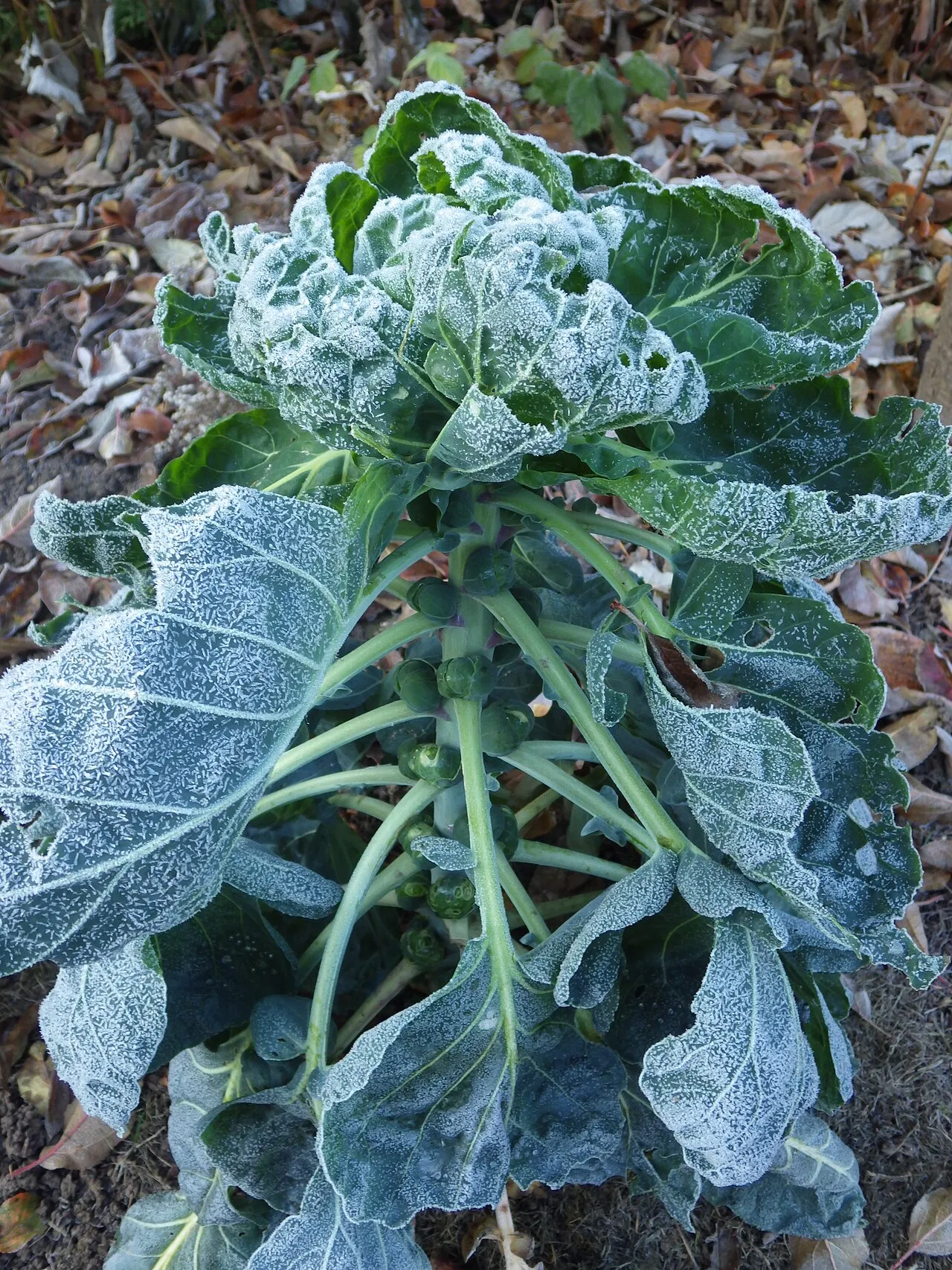
Frost makes them better. A light freeze improves the eating quality, and the crop is normally left standing in the garden well into winter and picked as needed. The plant in the photograph above is rimed with hoar frost and undamaged.
The practical consequence: time the crop so the sprouts mature in cold weather, not in summer. In most of the US that means setting out transplants in summer for a late autumn and winter harvest. Spring planting works only where summers stay cool.
Expect a long season, and do not trust the seed packet
Here is something worth saying plainly: the days-to-maturity figures given for Brussels sprouts are unreliable.
Published numbers vary enormously between sources and varieties, and in practice the crop takes far longer than most gardeners expect — this is one of the longest-season vegetables in the garden. Counting back from the packet number will usually have you planting too late.
The more dependable approach is to work from when you want to be harvesting, which is after your first frosts, and to plant early enough that the plant has a long stretch of growing before the weather turns. Local extension planting calendars are better guidance here than any national figure, because the right date depends entirely on when your autumn arrives.
Growing the plant
Full sun, and fertile, well-drained soil with steady moisture. Sprouts are a heavy, slow feeder and uneven water shows up directly in sprout quality.
They are tall and top-heavy — a mature plant on a long stalk in wet, windy autumn weather falls over readily. Stake them, or earth up around the base, before the weather gets rough rather than after.
Being a Brassica oleracea, the plant shares every pest and disease with cabbage, broccoli and kale: cabbage worms, aphids, flea beetles, clubroot. Rotate out of the brassica family for several years, and watch the undersides of leaves — aphids tuck into the sprouts themselves, where they are near impossible to wash out later.
Topping: a real disagreement between the experts
Topping means cutting off the growing tip at the top of the stalk, which stops upward growth and pushes the plant’s energy into the sprouts already formed. It makes the crop mature more evenly and more quickly.
It is also optional. An untopped plant still produces; it just ripens gradually from the bottom over a longer period, which some gardeners prefer.
If you do top, the sources genuinely do not agree on when:
- Iowa State gives when the lowest sprouts are ½ to ¾ inch across, and fewer than 60 days before you expect to harvest.
- University of Minnesota gives when the lowest sprouts are 1 inch across.
- University of Illinois gives about 3 weeks before harvest.
These are different instructions, not different wordings of one instruction. Three weeks is much later than “fewer than 60 days.”
What they share is the logic: top once the lowest sprouts have started to size up, and leave enough time afterwards for the rest to catch up. The size triggers — somewhere between ½ inch and 1 inch on the lowest sprouts — are easier to judge in the garden than a date, because they describe the plant in front of you rather than a forecast.
If you are undecided, split the difference and top when the lowest sprouts are around ¾ inch, four to five weeks out. Or leave the plant alone and pick gradually. Neither choice fails.
Harvesting
Sprouts mature from the bottom of the stalk upwards. They always have, and this governs how you pick.
Take the lowest sprouts first, at 1 to 1½ inches across and firm. Twist or snap each one off, and remove the leaf below it as you go — that keeps the stalk clear and lets light at the sprouts still developing above.
Then leave the plant standing and come back. A single stalk yields over weeks, and the ones you pick in December after several frosts will be the best of the crop.
Sprouts picked while they are still tight are worth more than big ones. Left too long, they loosen, the outer leaves yellow, and the flavour coarsens.
The short version
A long-season cool-weather crop that must mature in cold to be worth eating — plant for an autumn and winter harvest and let the frost reach it. Full sun, steady moisture, staking against autumn wind, and brassica rotation. Top the plant when the lowest sprouts are ½ to 1 inch if you want an even crop, or skip it and pick gradually. Harvest from the bottom up at 1 to 1½ inches, and keep going into winter.
- brussels sprouts
- brassica
- cool season crops
- topping
- frost