Native Shrubs
How to Grow and Care for Arrowwood Viburnum
Arrowwood needs a second, genetically different plant to set fruit — buying two of the same cultivar gives you flowers and no berries. A tough eastern native.
The Garden Magic Hub
- Zone
- 2–8
- Light
- Partial sun
- Water
- Moderate
- Level
- Beginner
- Season
- Spring, Fall
On this page
Arrowwood is one of the best native shrubs available to eastern gardeners — hardy from zone 2, adaptable to almost any soil, and genuinely valuable to wildlife. It also disappoints a lot of people who buy one, for a reason that has nothing to do with how they grow it.
You need two, and they must be different
NC State Extension states it plainly: “More than one genetic strain is needed to generate fruit.”
This is the single most important thing to know before buying. Arrowwood is largely self-incompatible, so a lone shrub — or two shrubs of the same named cultivar — will flower beautifully and set almost no berries. Cultivars are clones, so ‘Blue Muffin’ and another ‘Blue Muffin’ are genetically the same plant as far as pollination is concerned.
Buy two different cultivars, or a named cultivar plus a straight species plant, and site them within reach of the same pollinators. That is the whole difference between a shrub with flowers and a shrub covered in blue-black fruit that birds strip in autumn.
What it looks like through the year
Spring: creamy-white flowers in flat-topped corymbs up to 4 inches across, in March and April, with individual flowers about a quarter inch wide.
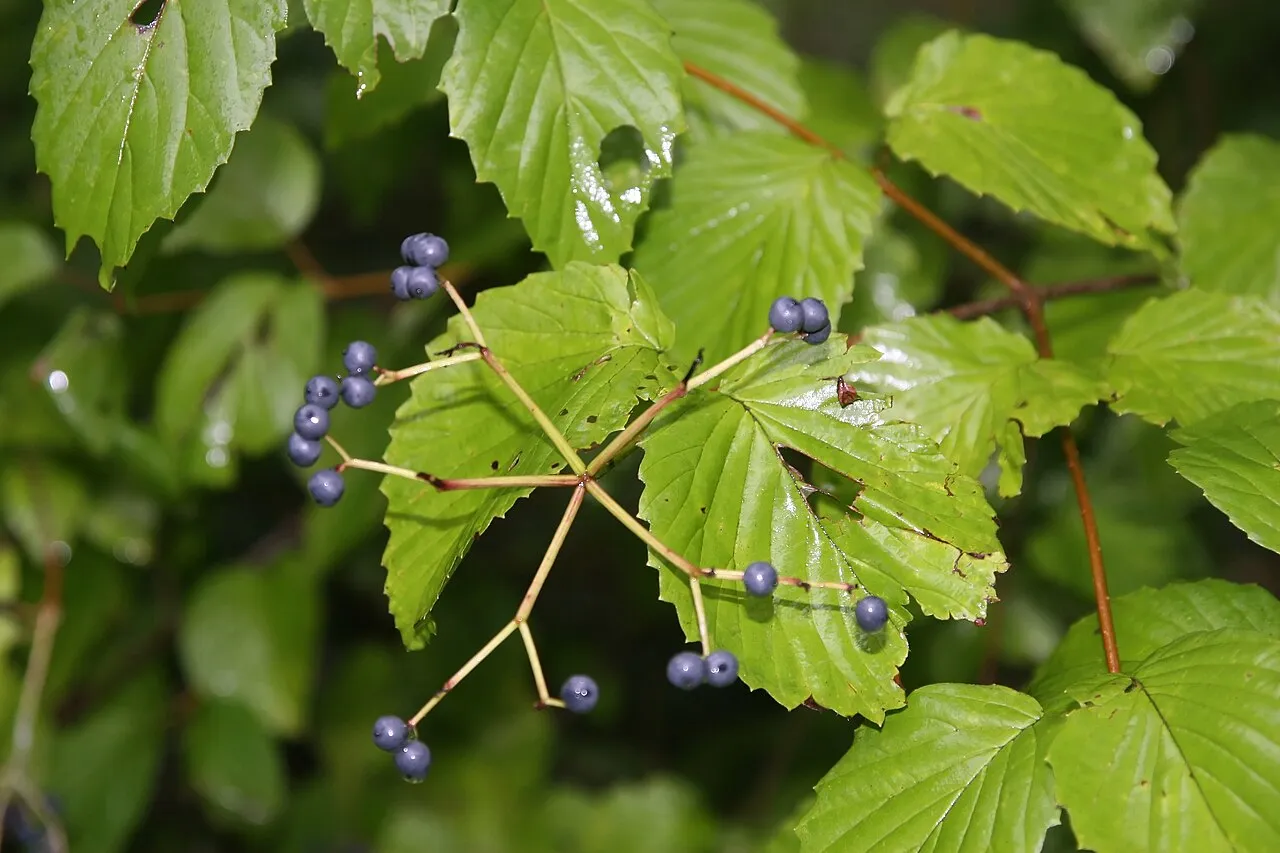
Summer into autumn: quarter-inch blue-black drupes from July through September, which NC State notes are attractive to birds and wildlife. They rarely last long once ripe.
The leaves are coarsely toothed — dentatum means toothed — and turn reasonable yellow to burgundy shades in fall.
Size and habit
5 to 10 feet tall and 6 to 10 feet wide, with some cultivars differing: ‘Morton’ reaches 12 feet.
It suckers with age, gradually widening into a thicket. NC State notes the suckers are easy to transplant, which makes it a cheap way to extend a hedge or screen. If you want a tidy single-stemmed shrub, expect to remove suckers annually.
Where it grows
Native to most of the eastern USA, along the coast to Texas, in stream banks and moist woodlands. Hardy in zones 2a through 8b — an unusually wide range, and it genuinely means zone 2.
Light: full sun or partial shade, both fine.
Soil: clay, loam, sand or shallow rocky ground, acid to neutral. It prefers moist, well-drained soil but NC State notes it tolerates shade with occasional drought or flooding, which is a rare combination and makes it useful in awkward spots — a rain garden edge, a damp corner, a shaded boundary.
Wildlife value
This is a genuine workhorse rather than a token native:
- Nectar for native bees from the spring flowers
- Food and shelter for birds — the fruit is taken quickly in autumn, and the thicket habit provides nesting cover
- Larval host plant, so it feeds caterpillars as well as adults
- Attracts butterflies
It is also deer-resistant, which is unusual among plants this useful.
Viburnum leaf beetle
This is the problem worth knowing about. NC State lists arrowwood as susceptible to viburnum leaf beetle, along with whiteflies.
The beetle is an introduced pest that has spread widely through the Northeast and Midwest. Both larvae and adults feed on the foliage, and repeated heavy defoliation over successive years can kill a shrub. Damage appears as leaves skeletonised between the veins, worst in late spring.
Viburnum dentatum is among the more susceptible species — that is worth weighing where the beetle is established. The practical control for a home gardener is to check the undersides of young twigs in late autumn or winter for the rows of egg-laying scars, and prune out and destroy infested twigs before spring hatch. That is far more effective than spraying later.
Some viburnums are notably resistant; if the beetle is a known problem locally, ask your extension office which species to plant instead.
The short version
An adaptable, cold-hardy eastern native for sun or shade, tolerant of both drought and occasional flooding, feeding bees, birds and caterpillars. Buy two genetically different plants or you will get no berries. And where viburnum leaf beetle is established, inspect twigs for eggs in winter and prune them out.
- arrowwood viburnum
- native shrubs
- cross pollination
- songbirds
- viburnum leaf beetle