Native Perennials
How to Grow and Care for Cardinal Flower
The best native hummingbird plant in the eastern US — and a wetland species that must never dry out. Here is how to site it and keep it going.
The Garden Magic Hub
- Zone
- 3–9
- Light
- Partial sun
- Water
- High
- Level
- Intermediate
- Season
- Summer, Fall
On this page
If you want hummingbirds and you garden anywhere in the eastern half of the country, cardinal flower is close to the top of the list. It has one requirement, and it is absolute.
Never let it dry out
NC State Extension asks for rich, medium to wet soil with consistent moisture, notes it will tolerate brief flooding, and states that the plant “should never be allowed to dry out.”
Cardinal flower grows wild along streambanks, in wet meadows, and at pond margins. It is a wetland plant that happens to be beautiful, and treating it as an ordinary border perennial is the standard way to lose it.
Where it thrives:
- Rain garden bottoms and swales
- Pond and stream margins
- Beside a downspout
- Low, damp areas that stay wet after rain
Where it will die: a free-draining sunny border that dries between waterings.
If you have no naturally damp spot, heavy organic matter plus mulch plus committed watering can work — but you are compensating for the site every week all summer, and one hot fortnight away from home can end it.
The hummingbird design
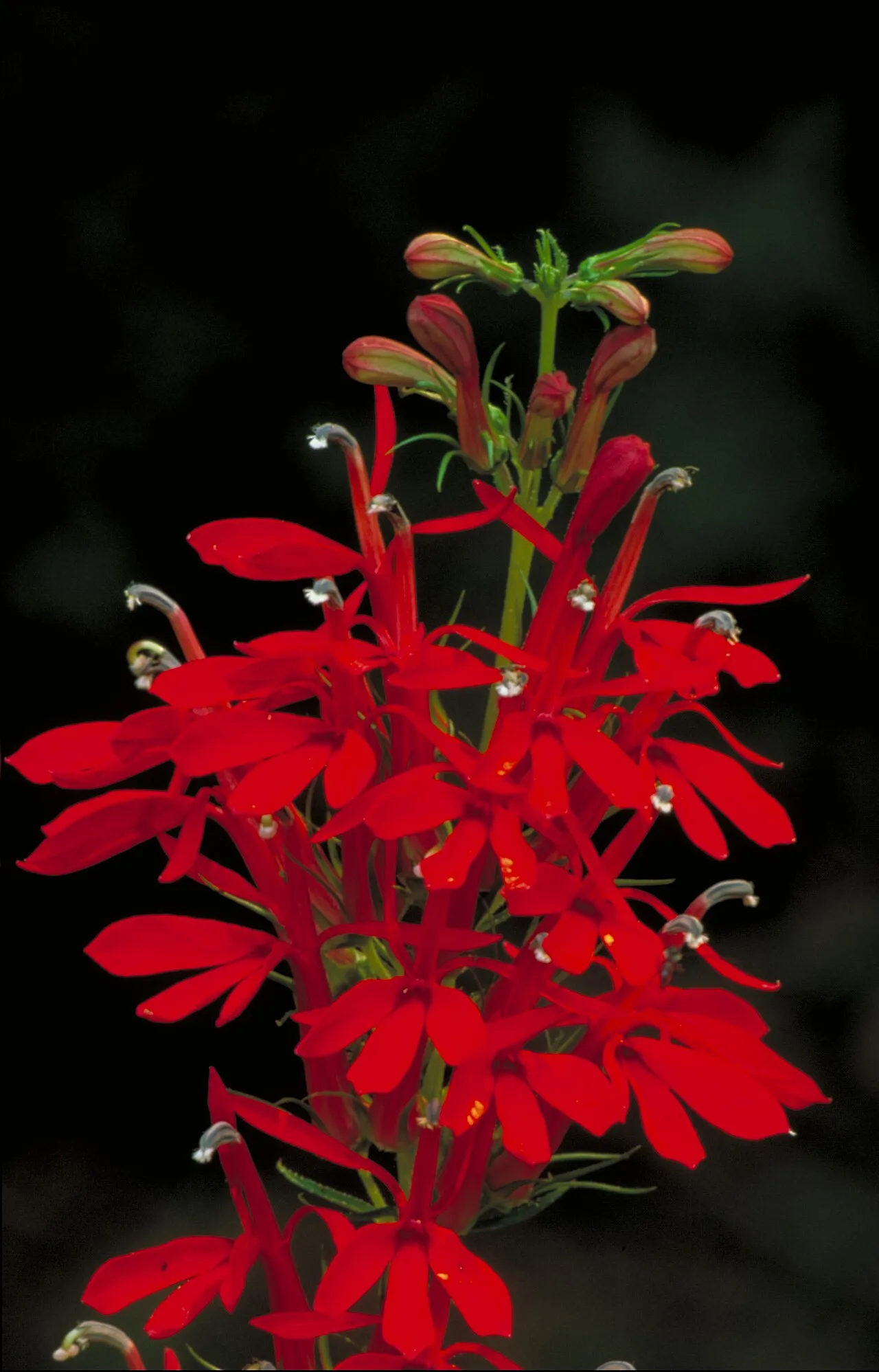
The flowers are erect terminal spikes of large, cardinal red, two-lipped blooms, with the three lobes of the lower lip more prominent, from July through October.
NC State notes they are attractive to hummingbirds, and the structure explains why. Red, tubular, unscented, with no landing platform and nectar held deep — that combination is close to a textbook description of a bird-pollinated flower. Most insects cannot reach the nectar; a hummingbird hovering in front of it can.
The reproductive column protrudes above the flower precisely so it brushes the bird’s forehead as it feeds.
The spike opens from the base upward, which is worth knowing because it means a single stem provides nectar for weeks rather than days — and a planting of several stems at different stages covers most of late summer, exactly when hummingbirds are fuelling for migration.
Size and light
4 to 5 feet tall and 1 to 2 feet wide — considerably taller than people expect, and narrow, so plant it in groups of three or more rather than singly.
Light: full sun, partial shade, or dappled sunlight. In full sun it needs the most water; in part shade it is more forgiving. For most gardens, part shade with wet feet is the easier combination.
Keeping it going
Cardinal flower is not a long-lived perennial, and this is the practical thing to manage.
It overwinters as a basal rosette of leaves at ground level, and NC State’s propagation note points at the method: “by seed or by separating the rosettes from the parent plant in the spring.” A healthy plant produces offset rosettes around the crown, and separating and replanting these every couple of years keeps the colony going indefinitely.
Two things protect that rosette over winter:
Do not bury it in mulch. A rosette smothered under heavy mulch rots. Keep mulch pulled back from the crown.
Let it self-seed. The seed is tiny and needs light to germinate, so leave some seedheads standing and do not mulch over the area where seedlings should appear. Volunteers are how this plant persists in the wild.
Problems
Slugs and snails damage the foliage, and they are drawn to exactly the damp conditions the plant needs. That is the main pest issue.
Toxicity: NC State rates it medium severity, “toxic only if large quantities eaten”, with flowers, leaves, roots, seeds, stems and sap all containing the compounds. Symptoms include nausea, vomiting and diarrhoea. Worth knowing, not worth avoiding the plant over.
The short version
A tall native for damp ground in sun or part shade, flowering scarlet from July to October and feeding hummingbirds through migration. Never let it dry out — a rain garden or pond edge is ideal. Keep mulch off the winter rosette, separate the offsets every couple of years, and leave some seed to fall.
- cardinal flower
- lobelia
- hummingbirds
- native plants
- rain gardens