Native Perennials
How to Grow and Care for Blue-Eyed Grass
Blue-eyed grass is not a grass — it is a miniature native iris. Easy, tough and long-flowering, provided you cut it back before it seeds itself everywhere.
The Garden Magic Hub
- Zone
- 4–9
- Light
- Full sun
- Water
- Moderate
- Level
- Beginner
- Season
- Spring
On this page
Blue-eyed grass is one of the easiest native perennials to grow, and the name is wrong in the most interesting way.
It is an iris
NC State Extension is clear that despite the common name, blue-eyed grass is not a true grass — it sits in the iris family, Iridaceae, with the characteristic sword-shaped leaves of that family.
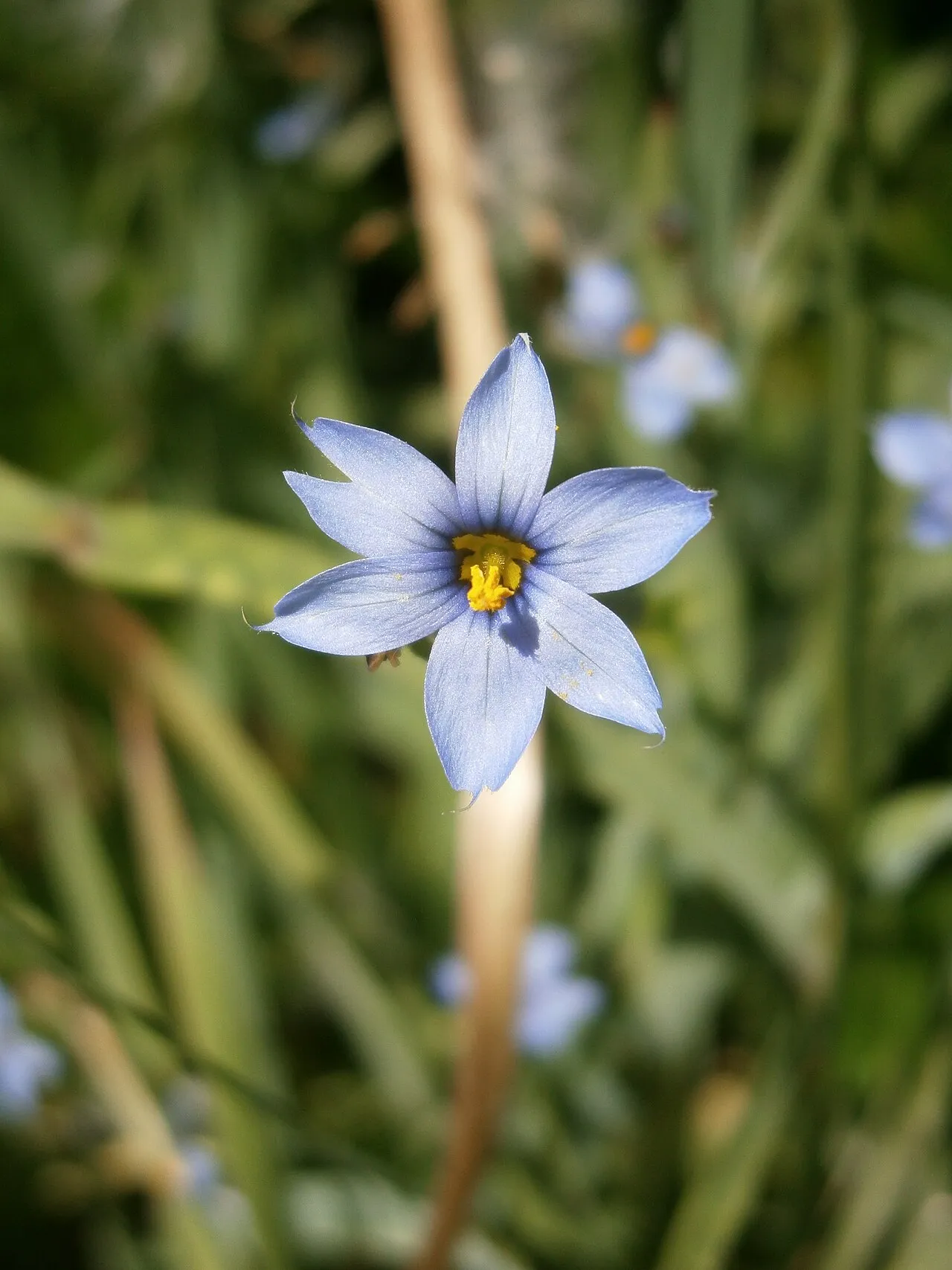
Look at the flower and the family is obvious: six tepals arranged around a bright yellow eye, with the symmetry of a tiny iris rather than the inconspicuous structure of a grass flower. The stems are flattened rather than round, which is another iris trait.
The foliage is what causes the confusion — narrow, upright, grassy-looking clumps that disappear into a lawn or meadow until the flowers open.
Native across most of the East
NC State lists it as native across an enormous swathe of North America — from Maine and Minnesota south to Florida and Texas, and most states between.
Hardy in zones 4a to 9b, which is nearly everywhere in that range.
If you are planting for wildlife or for a native meadow, this is one of the low-effort, genuinely regional choices — it belongs almost anywhere east of the Plains.
The flowers
Half-inch, delicate, bright blue-violet flowers with a yellow eye, blooming March to June depending on latitude.
Individual flowers are short-lived — often a single day — but a clump produces them in succession over weeks. The effect is a haze of small blue stars rather than a display of individual blooms, which is why it works best planted in drifts rather than as single specimens.
Size and conditions
1.5 to 2 feet tall and 6 inches to a foot wide. Compact enough for the front of a border, a path edge or a rock garden.
Light: full sun or partial shade — it takes both.
Soil and moisture: flexible. NC State lists it as tolerating moist conditions and occasionally dry soils, which covers most ordinary garden ground. It grows naturally in damp meadows and open woods, so consistently moist is ideal, but it is not fussy.
That adaptability is the reason to grow it. Few native perennials are this tolerant of both sun and part shade, and both moisture and periodic dryness.
It self-seeds — cut it back
Here is the one maintenance job.
NC State notes it is self-seeding and that “it should be cut down after blooming in order to avoid unwanted spread.”
Whether that matters depends on the setting. In a meadow, a naturalised area or a wild-edged border, self-seeding is the point — the colony sustains itself and spreads into gaps. In a tidy formal bed it means seedlings coming up through everything the following spring.
So: shear the clumps back after flowering finishes if you want to keep it contained, or leave the seedheads if you want more.
Cutting back has a second benefit — the foliage often looks tired after flowering, and shearing produces a fresh flush of clean green leaves for the rest of the season.
Dividing
Every few years, to keep the plants healthy, by division.
Unlike many natives, this one genuinely benefits from periodic division — clumps thin out and lose vigour at the centre with age. Lift and split in early spring or after flowering, and replant the outer sections.
Wildlife value
Small early flowers on a native plant are more useful than they look. Blue-eyed grass provides nectar in spring when relatively little else is open, and it fits into meadow and lawn-alternative plantings without dominating anything.
The short version
A tough little native iris that looks like a grass. Full sun to part shade, ordinary soil, moist or occasionally dry — it copes with most of it. Plant it in drifts, shear it after flowering to control the self-seeding, and divide every few years to keep the clumps vigorous.
- blue-eyed grass
- sisyrinchium
- native plants
- self-seeding
- iris family