Native Shrubs
How to Grow and Care for Beautyberry
American beautyberry fruits on new wood, so cutting it to a foot each winter is what produces the best display. A tough native shrub that feeds songbirds.
The Garden Magic Hub
- Zone
- 6–10
- Light
- Partial sun
- Water
- Low
- Level
- Beginner
- Season
- Fall
On this page
American beautyberry is one of the easiest native shrubs to grow and one of the most under-planted, largely because it looks unremarkable for ten months of the year and then does something no other hardy shrub does.
What it is
Callicarpa americana is native to the central and southeastern United States, and NC State Extension lists its range across AL, AR, FL, GA, KY, LA, MD, MS, MO, NC, OK, SC, TN, TX and VA, plus Bermuda and Cuba.
Hardy in zones 6a to 10b, reaching 3 to 8 feet tall and 3 to 6 feet wide — a loose, arching, informal shrub rather than a tidy one.
The berries
Small flowers appear in clusters where the leaves meet the stems from late spring into early summer, in blue, violet, pink or white. They are easy to miss.
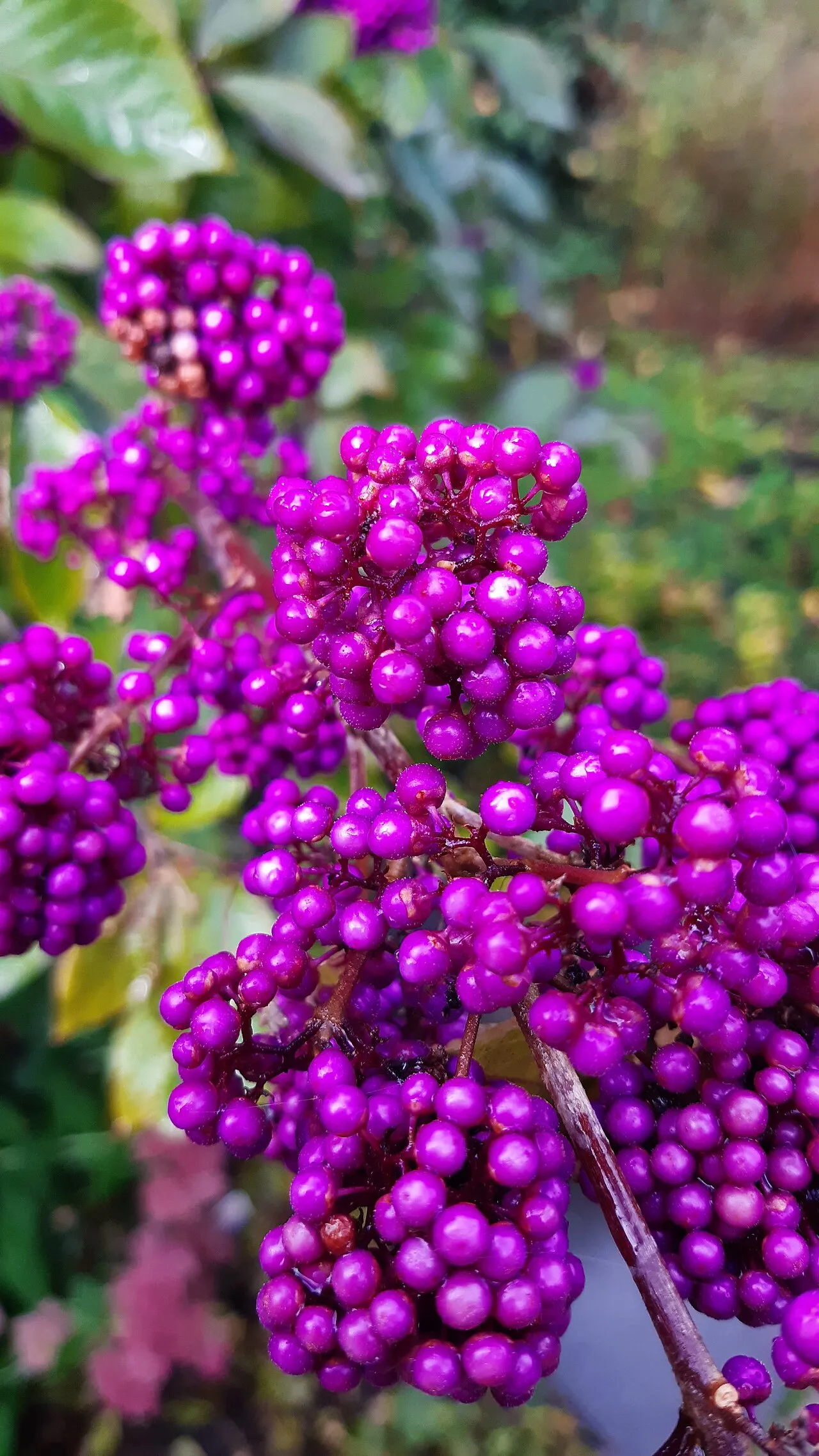
The fruit is the point. Clusters of purplish to bluish berries develop from August through October, roughly a quarter inch across, and they form whorls that wrap around the stem at each leaf joint rather than hanging in bunches at the tips. The colour is a saturated magenta-purple that reads as almost artificial.
They may last through early winter, holding on after the leaves drop, which is when the shrub looks best — bare arching stems strung with beads of purple.
Prune it hard, and do not feel bad about it
This is the piece of information that changes how the shrub performs.
NC State notes that “flowers and fruits appear on new shoots”, and the recommendation follows directly: prune in late winter to 1 foot high.
Cutting a shrub back to a foot feels drastic. For this plant it is correct. Because fruit is carried on the current season’s growth, hard pruning produces vigorous new shoots and a heavier crop of berries, on a plant that stays dense rather than becoming a sprawling thicket of old wood.
Do it in late winter while dormant, before growth starts. An unpruned beautyberry still fruits, but it gets leggy and the display thins out.
Site and soil
Full sun to part shade. It is explicitly intolerant of deep shade — plants in heavy shade grow leggy and fruit poorly, which is the other common reason for disappointment.
Soil is easy: clay, loam, sand or high organic matter, from acid to alkaline pH, provided drainage is good.
Once established it is drought tolerant and copes with dry soil. That combination — native, adaptable, drought tolerant, few pests — is what makes it such a low-input shrub.
Wildlife value
This is a genuine wildlife plant rather than a nominal one.
The berries feed songbirds including robins, thrashers, finches and towhees, plus small mammals — raccoons, foxes and squirrels. Because the fruit persists into early winter, it provides food at a point in the season when little else is available.
The flowers, though small, are worked by bees and other pollinators through early summer.
Deer
NC State lists it as deer and rabbit resistant, with an honest qualification worth repeating: deer will browse the leaves in summer and eat fallen fruit.
“Resistant” here means it is not a preferred food and will usually survive, not that deer ignore it. In heavy deer pressure expect some summer leaf damage on a plant that still fruits.
Problems
NC State records no significant pest or disease issues, which is unusual enough to be worth stating plainly. This is a genuinely trouble-free shrub in its range.
The short version
A tough native for full sun to part shade, drought tolerant and pest-free, growing 3 to 8 feet. Cut it back to a foot in late winter — it fruits on new wood, so hard pruning is what produces the display. Then leave it to feed the birds from August into winter.
- beautyberry
- native shrubs
- songbirds
- hard pruning
- drought tolerant