Wildlife Gardening
What Native Bees Need That Honeybees Do Not
Most native bees are solitary and ground-nesting. Why bee hotels are oversold and bare soil is undervalued.
The Garden Magic Hub
- Level
- Intermediate
On this page
Most bees are not honeybees, and they do not live in hives
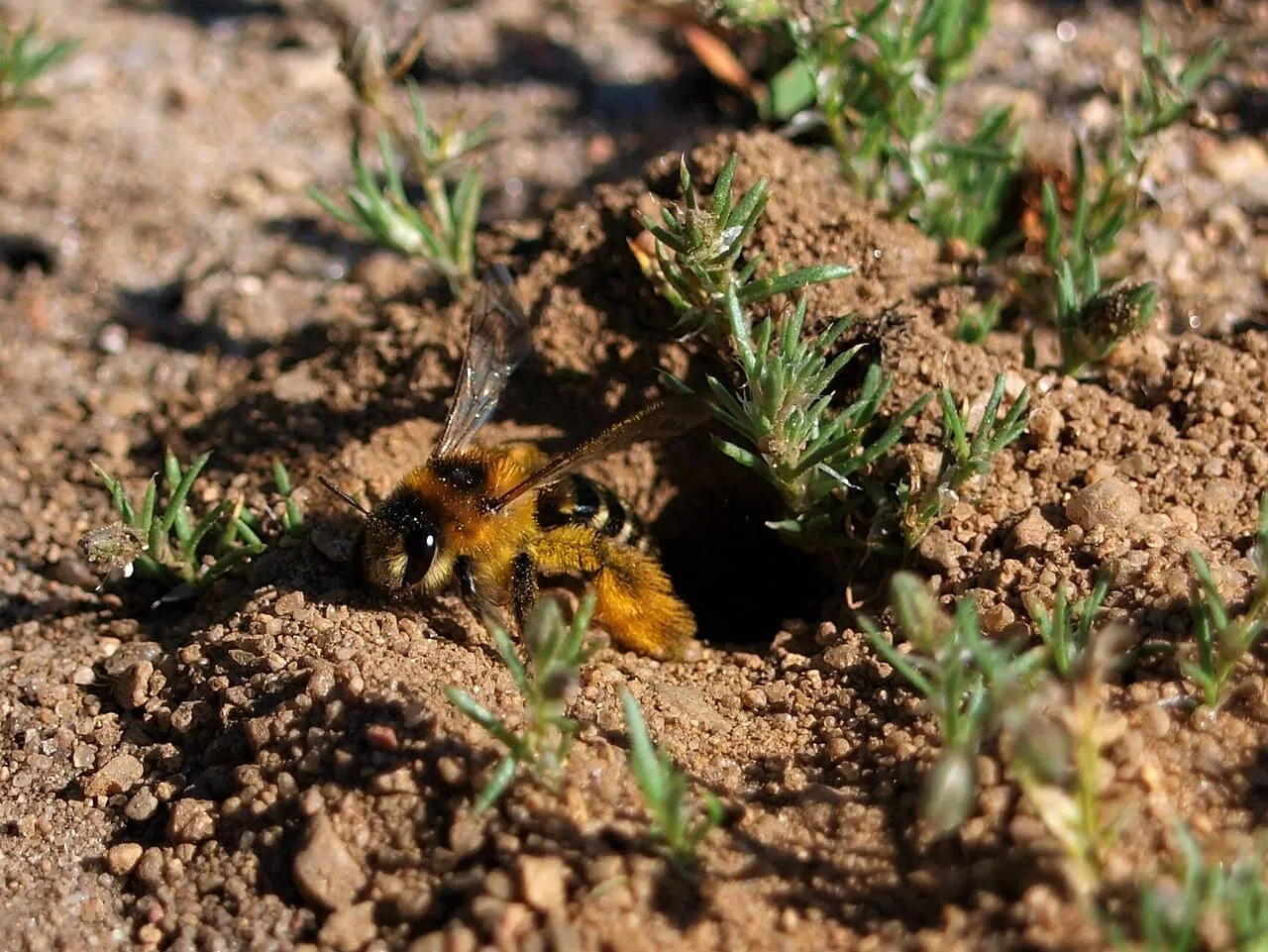
Of roughly 4,000 bee species in North America, more than 90% are solitary. A single female builds her own nest, provisions it herself, and dies. There is no colony, no honey, and almost never any interest in stinging you.
They are also frequently better pollinators than honeybees per individual, and many are specialists that particular native plants depend on.
Gardening for them is not the same as gardening for honeybees, and the difference is mostly about nesting.
Where they actually nest
Xerces Society figures split them roughly:
- About 70% nest in the ground — burrows excavated in bare or sparsely vegetated soil.
- About 30% nest in cavities — hollow plant stems, beetle tunnels in dead wood, pithy stems they hollow out themselves.
Both groups are undone by tidiness, and in different ways.
Bare soil is habitat, not neglect
This is the single most useful thing to know, and it runs directly against normal garden practice.
Xerces notes that even a 1-inch layer of mulch can be as impenetrable as pavement to small ground-nesting bees. Fully mulched beds are, from their point of view, paved.
What they want is sunny, well-drained, undisturbed ground with sparse or no vegetation. A bank, a path edge, a dry corner, the base of a south-facing wall.
Leave some. It does not need to be large, and it does need to be left alone — these are nests, so digging them over in spring destroys them.
Stems are the other half
For cavity nesters, the material is dead stems.
NC State Extension gives a specific and practical method: trim perennial stems in their first winter to a 12 to 24 inch stubble. Bees occupy those cut stems as nesting space over the following year.
That is a genuinely usable compromise — the garden gets cut back and the habitat stays. Cutting to the ground removes it entirely.
Leave dead wood too, where you can. A log pile or an old stump is nesting material.
Bee hotels: be careful
They are popular, well-intentioned, and frequently harmful.
NC State Extension is direct about the problem: when not properly maintained, these structures “become a sponge for pathogens and mites which build up in the nesting material over time.” A bee hotel left up for years concentrates disease and can do more damage than doing nothing.
If you use one, it has to be maintained — replaceable liners or tubes, cleaned or renewed annually, sited out of driving rain. An unmaintained bee hotel is a decoration with a cost.
Bare soil and stem stubble need no maintenance at all, and support far more species.
Then the flowers
Natives first, because specialist bees cannot use anything else. Single rather than double flowers. Overlapping bloom from early spring to autumn — early-emerging species need March and April forage, which most ornamental gardens do not provide.
And no insecticides on anything flowering.
- native bees
- solitary bees
- nesting
- habitat