Wildlife Gardening
Why Pollinators Are Not Visiting Your Garden
A garden full of flowers can still be useless to bees. What they are actually looking for, and what they cannot use.
The Garden Magic Hub
- Level
- Intermediate
On this page
A garden full of flowers can still be nearly useless
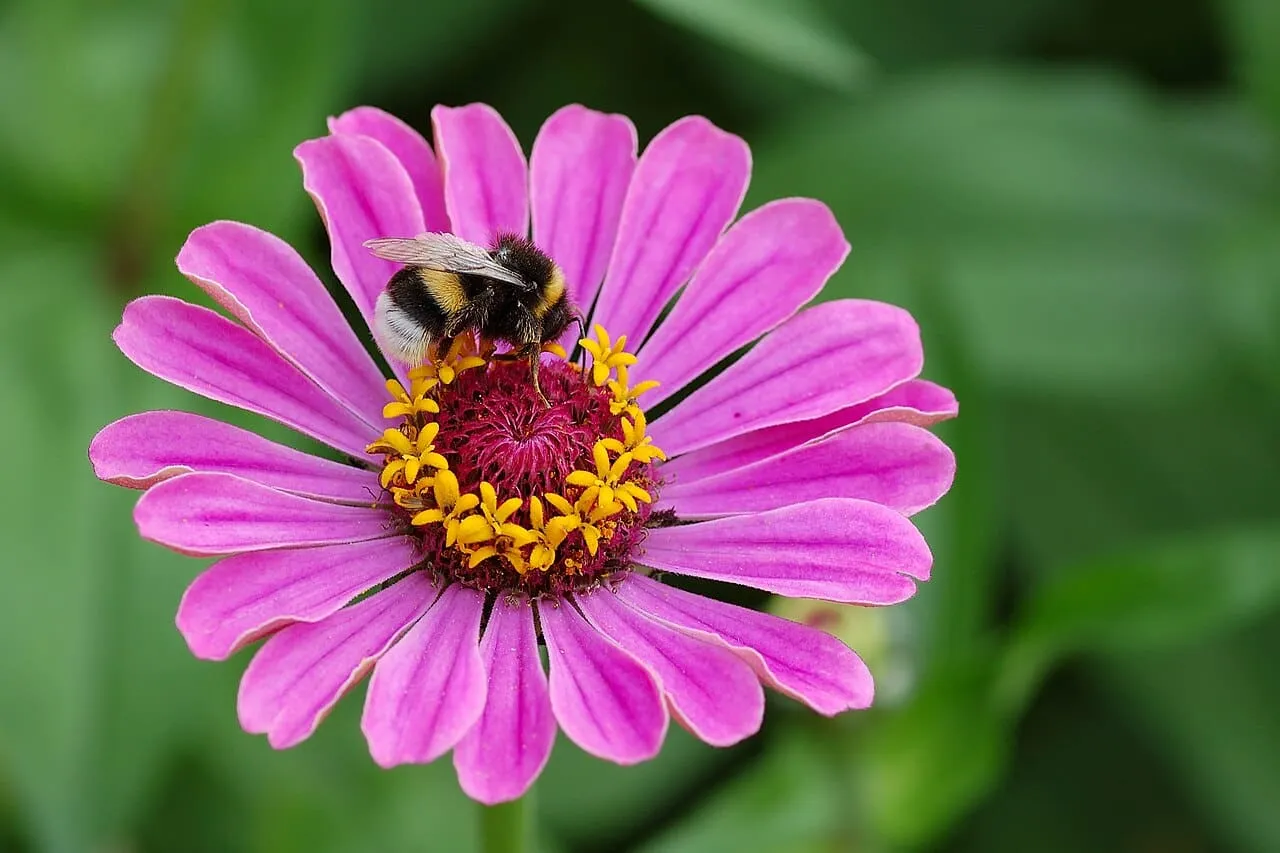
Most gardens planted “for pollinators” are planted for one pollinator: the honeybee. It is not native to North America, it is a managed livestock species, and it is not the one in trouble.
The bees that need help are the natives, and there are a great many of them — roughly 4,000 species in North America, of which more than 90% are solitary rather than living in hives.
Solitary bees have different requirements from a hive, and a border of nectar-rich flowers meets only half of them.
Flowers are half the problem. Nesting is the other half
This is the part almost every “pollinator garden” article omits.
Xerces Society data puts around 70% of native bees as ground-nesting — they excavate burrows in bare soil — with the remaining 30% nesting in cavities: hollow stems, beetle holes in dead wood, and similar.
Now consider a tidy garden. Every bed mulched, every stem cut down in autumn, no bare ground anywhere. There is nowhere for either group to nest.
The Xerces figure that should change how you garden: even a 1-inch layer of mulch can be as impenetrable as pavement to small ground-nesting bees.
What to change
Leave some bare soil. Sunny, well-drained, undisturbed patches — a corner, a bank, the edge of a path. It looks like neglect and it is habitat.
Leave stems standing. NC State Extension recommends trimming perennial stems in their first winter to a 12 to 24 inch stubble, which bees then occupy as nesting space the following year. Cutting everything to the ground removes it.
Stop mulching everything. Mulch has real benefits, which is why this is a trade-off rather than a rule. Mulch the beds that need it; leave some ground open.
Then the flowers
If nesting habitat exists and pollinators still are not coming, look at what you have planted.
Native plants. Many native bees are specialists tied to particular plant families and cannot use ornamental exotics at all.
Single flowers, not doubles. Highly bred double flowers often have their reproductive parts replaced by extra petals — no pollen, no nectar, and frequently no access even if there were.
Overlapping bloom, spring to autumn. A garden that peaks in June and offers nothing in September supports nothing through September.
Plant in drifts. Several plants of one species together are far more findable and more efficient to forage than one of everything.
And stop spraying
Insecticides applied to flowering plants kill pollinators, including products marketed as organic. Neonicotinoids are systemic and persist in plant tissue including pollen and nectar.
If the goal is pollinators, the pesticide cabinet is working against you regardless of what the label promises.
- pollinators
- bees
- native plants
- nectar