Ferns
How to Grow and Care for Bird's Nest Fern
A rainforest epiphyte that feeds itself by trapping falling debris in its rosette. That one fact explains almost everything about growing one indoors.
The Garden Magic Hub
- Zone
- 11–12
- Light
- Shade
- Water
- High
- Level
- Intermediate
On this page
Bird’s nest fern looks nothing like a fern is supposed to — broad, undivided, glossy fronds instead of finely divided ones. Understanding where it grows in the wild explains both the shape and most of the care.
It is an epiphyte that farms its own compost
NC State Extension describes Asplenium nidus as naturally epiphytic, growing on tree trunks and branches in tropical rainforests — not in soil at all.
And it feeds itself in a specific way. NC State calls it a “litter trapper”: the funnel-shaped rosette collects falling debris, which breaks down in the centre of the plant and becomes its nutrient supply.
That single fact explains the plant:
- The shape is a funnel because the funnel is a collecting device, not decoration.
- It wants an open, organic, fast-draining medium rather than dense soil, because in nature its roots sit in bark and leaf litter.
- It wants constant moisture and humidity, because an epiphyte has no soil reservoir to fall back on.
Light
Dappled sunlight, or partial shade with 2 to 6 hours of indirect sun. Think canopy shade — which is exactly what it gets in the wild.
NC State notes that excessive light causes yellowing or stunted growth. A bird’s nest fern going pale is usually too bright, not underfed. Direct sun scorches the fronds quickly.
Water and humidity
Moist soil that cannot be allowed to dry out, and high humidity — NC State suggests a pebble tray of water may be needed to supply enough.
The same rules as any indoor fern apply: heated winter air is the enemy, and a bathroom, a kitchen, or a humidifier does far more than misting.
On watering the crown: NC State does not address it. The commonly repeated advice is to water the soil rather than pouring into the central rosette, reasoning that a plant in a pot has much less airflow and drainage through its crown than one perched on a rainforest branch, so trapped water can rot the growing point. That reasoning is sound, but I have not found it stated by an extension source — treat it as a sensible precaution rather than an established rule.
Soil
High organic matter, loam-based, acidic below pH 6.0, with good drainage. NC State’s suggestion is a fern potting mix.
Do not use dense general-purpose compost. Something open and bark-based suits an epiphyte far better.
Size
3 to 5 feet tall and 2 to 3 feet wide at maturity, which surprises people who bought a small one. Given time this is a large plant that needs floor space rather than a shelf.
Handle it gently
NC State includes an unusual instruction: “Fragile foliage, handle gently.”
New fronds unfurl soft and are permanently marked by handling — a crease or a fingernail dent stays for the life of that frond. Site the plant where it will not be brushed past, and resist the urge to wipe the leaves.
Also on the list: avoid direct heat, drafts, and chemical insecticides. That last one matters. Ferns are notably sensitive to insecticidal sprays, including some labelled safe for houseplants. If you must treat pests, test on one frond first, or wipe the insects off by hand.
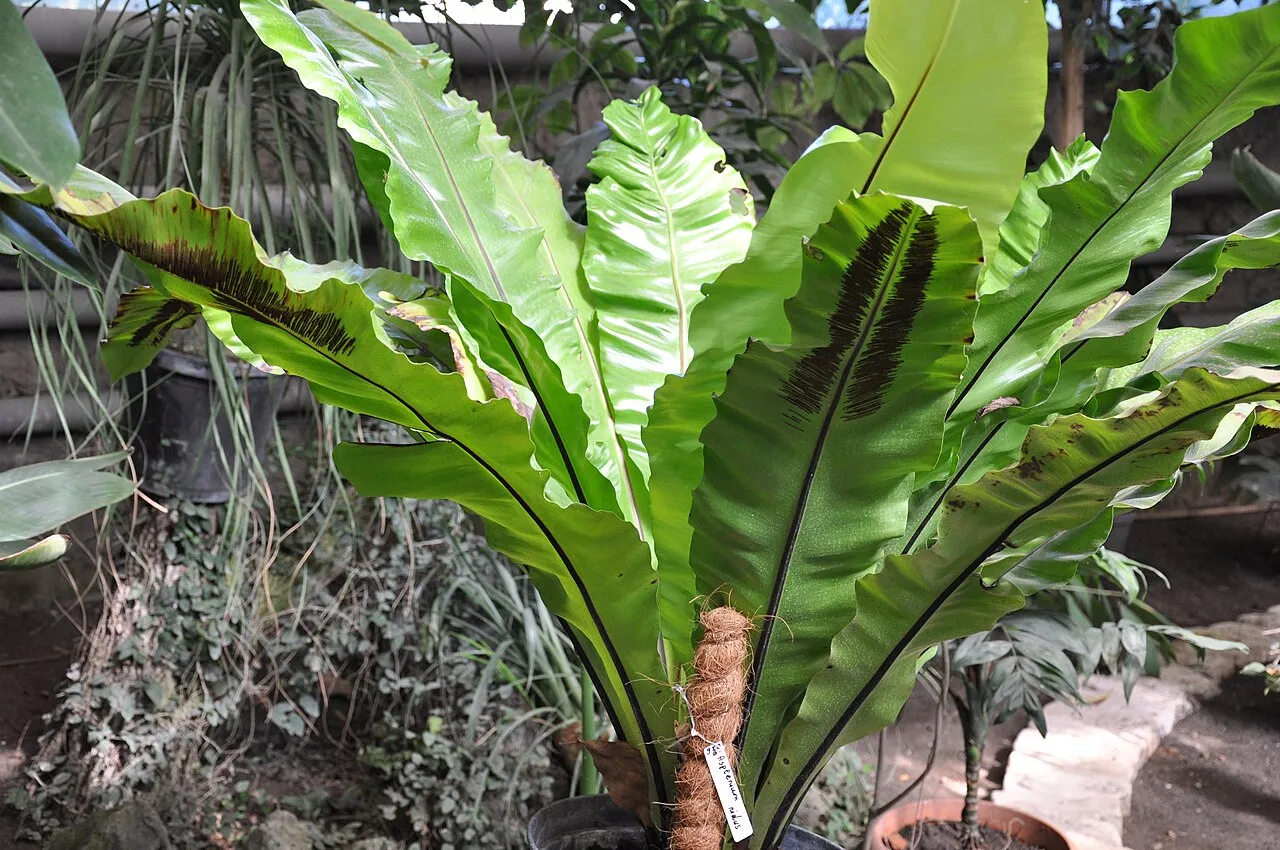
Those brown bars are spores
Visible on two fronds in the photograph above: dark brown linear marks running out from the midrib on the underside.
These are sori — spore cases — and they are how the fern reproduces. They are regular, symmetrical, and repeat identically along the frond. Scale insects are irregular, scattered, and can be scraped off with a fingernail. The same confusion arises with Boston fern, and it sends people spraying perfectly healthy plants every year.
Pests and problems
Slugs and snails if it summers outdoors, plus scale, mealybugs, bacterial leaf diseases and leaf nematodes indoors.
Brown, mushy patches spreading across a frond suggest bacterial leaf disease, usually from water sitting on foliage in still air. Remove affected fronds and improve air movement.
The short version
A rainforest epiphyte: dappled shade, a coarse bark-based acidic mix, constant moisture and real humidity. Do not let it dry out, do not put it in a draft, do not spray it with insecticide, and do not handle the new fronds. And the brown bars underneath are spores, not pests.
- bird's nest fern
- asplenium
- epiphyte
- humidity
- spores