Tropical Foliage
How to Grow and Care for Money Tree
The braided trunk is a 1980s Taiwanese nursery technique, not how the plant grows. Here is what a swamp tree from Central America actually needs indoors.
The Garden Magic Hub
- Zone
- 10–12
- Light
- Partial sun
- Water
- Moderate
- Level
- Beginner
On this page
The money tree is sold as a good-luck object more than as a plant, which means most people never learn the one fact that explains its care: it is a swamp tree.
Where it comes from, and why that matters
NC State Extension places Pachira aquatica in the mallow family (Malvaceae) — the same family as hibiscus, okra and abutilon — and gives its native range as southern Mexico to Bolivia and northern Brazil, growing in tropical freshwater swamps and rainforests.
The species epithet aquatica is doing real work. This is a plant adapted to ground that is wet a lot of the time, and that produces a specific and slightly contradictory set of needs indoors: it dislikes drying out, and it also cannot sit in standing water in a pot.
The resolution is drainage. Consistent moisture moving through an open mix is what a swamp margin actually provides — not a saucer of stagnant water.
The braid is manufactured
Worth knowing, because people assume they have bought something that grew that way.
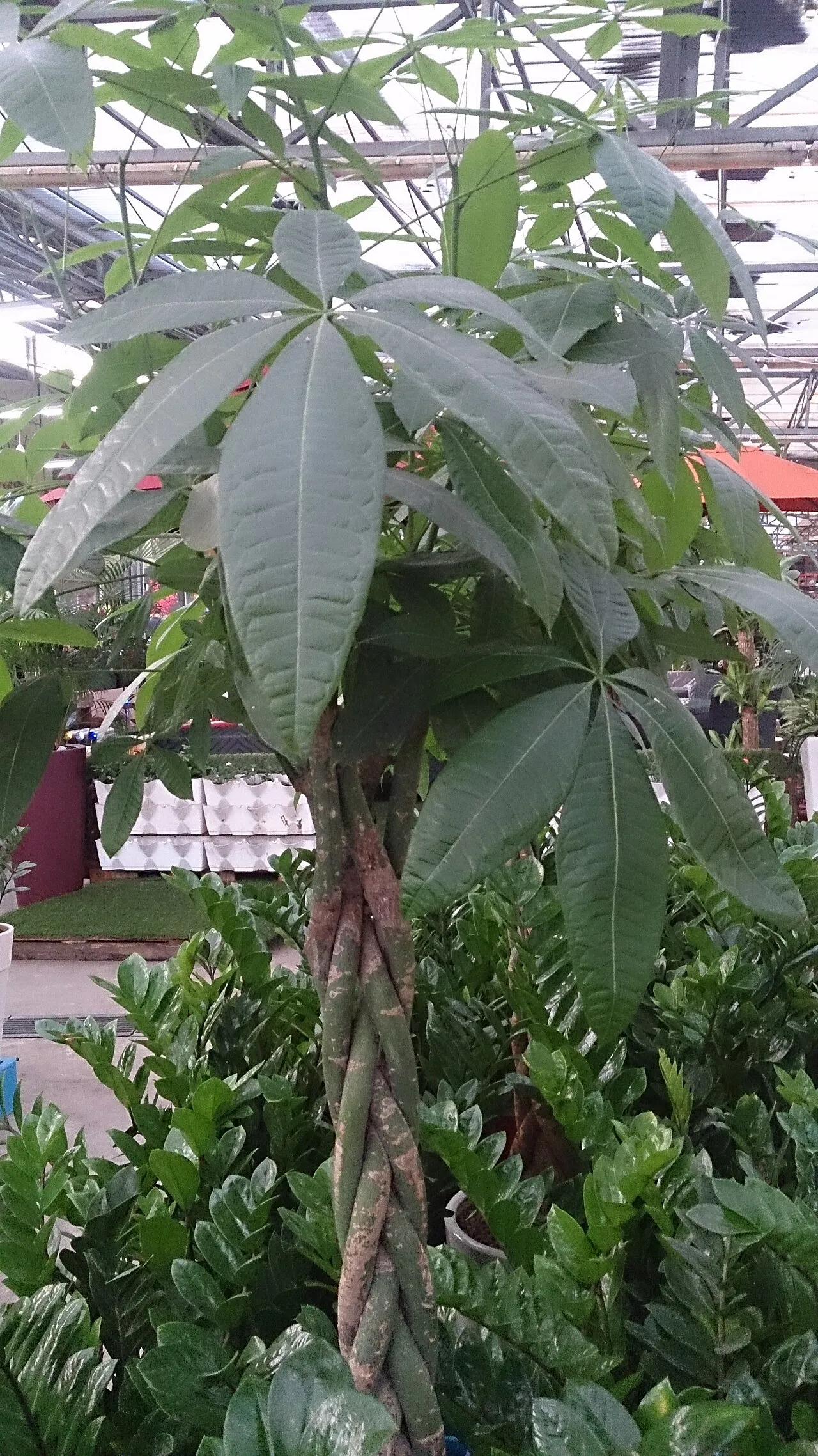
The braided trunk is human-made. NC State explains that the trunks are flexible enough to be braided together, and dates the technique to Taiwan in the 1980s. What you have is not one tree with a decorative stem; it is typically five young plants, planted together and woven while their stems were still green and pliable.
That has practical consequences:
- If one strand dies, the braid keeps going with a gap. You cannot regrow it.
- The braid does not tighten itself. As the trunks thicken they fuse somewhat, but a newly bought plant may need the top of the braid loosely tied until it sets.
- The plant does not need the braid. Left alone it grows as a normal tree, and there is nothing wrong with letting an unbraided top develop naturally.
Size
Outdoors in its range it reaches up to 30 feet. As a houseplant NC State gives 6 to 8 feet in most homes.
That is still a substantial plant. The tabletop specimens sold in small pots are young, and they will outgrow a shelf.
Light
Indirect sunlight, or a mix of sun and shade. Direct sun scorches the leaves.
An east or north window, or a few feet back from a brighter one, suits it. Money trees tolerate moderate light better than most large-leaved tropicals, which is part of why they sell so well as office plants — but very low light produces sparse, stretched growth.
Water, and the two failure modes
NC State asks for a moist, well-drained potting mix of peat moss with perlite, loam or sand, and is explicit that “standing water is not tolerated and can cause root rot.”
The two ways money trees die are opposite and both common:
Too dry. NC State notes that leaf drop occurs when the soil becomes too dry. A money tree shedding leaflets is usually telling you it has been left too long, not that something exotic is wrong.
Too wet. Root rot from a pot with no drainage hole, or from a decorative outer sleeve that quietly fills with water. Check the cachepot — this is the single most common way office money trees die.
Water thoroughly when the top inch or two is dry, let it drain fully, and empty the saucer.
Warmth and humidity
NC State’s range is 65 to 75°F in a humid environment, and bringing plants indoors before temperatures reach 45°F.
Household air in winter is drier than it likes. A pebble tray, a humidifier, or grouping it with other plants all help; brown leaf edges are usually the first sign that the air is too dry.
Propagation
Softwood cuttings, layering, or seed.
Cuttings are the practical route indoors. Note that a plant grown from a single cutting will have one trunk — if you want a braid, you need several young plants started together.
Toxicity
NC State rates it low severity. The caveat is specific: some sources state that the seeds are potentially toxic, containing cyclopropenoid fatty acids.
The seeds are only relevant on a mature flowering plant, which a houseplant will not be. Treat the foliage as low risk and do not eat the nuts.
Problems
Aphids, mealybugs, scale and fungus gnats are the pests. Fungus gnats in particular signal chronically wet potting mix, so they double as a watering diagnostic.
Diseases are anthracnose, powdery mildew and root rot — all favoured by wet foliage, still air, or saturated soil.
The short version
A swamp tree from Central and South America, so it wants steady moisture in a mix that drains freely and never standing water. Bright indirect light, 65 to 75°F, humidity if you can. Leaf drop means too dry; a soggy base means too wet. And the braid is a nursery technique from 1980s Taiwan, not the plant’s own idea.
- money tree
- pachira
- braided trunk
- leaf drop
- root rot