Pollinator Perennials
How to Grow and Care for Agastache
Agastache dies in winter wet, not winter cold. Pick between the blue hyssops and the warm-toned hummingbird mints, then get the drainage right.
The Garden Magic Hub
- Zone
- 5–10
- Light
- Full sun
- Water
- Low
- Level
- Intermediate
- Season
- Summer
On this page
Agastache is one of the best pollinator perennials available to US gardeners and one of the most reliably killed by its owners — almost always in the same way, and almost always in February rather than July.
Winter wet, not winter cold
NC State Extension is blunt about what finishes them: “wet winter feet in poorly drained soil will do them in.”
This is the whole plant in one sentence. Agastache are hardy through zones 5a to 10b and shrug off cold. What they cannot survive is sitting in cold, saturated ground while dormant, and that is why so many gardeners lose a plant that looked perfect all summer and simply never came back.
NC State’s requirement is unusually firm: “well-drained soils are essential,” with raised beds or containers recommended where drainage is poor.
If your soil is heavy clay, do not amend the planting hole and hope. Raise the bed, plant on a slope, or grow agastache in a pot. And do not mulch heavily against the crown going into winter — that traps exactly the moisture you are trying to avoid.
Two very different halves of the genus
There are about 22 species, split into a North American group and an Asian one, and in the garden that translates into two distinct kinds of plant. Choosing between them is the second decision after drainage.
The blue and purple hyssops. Dense upright bottlebrush spikes in blue and violet, bee magnets, generally taller and leafier. ‘Blue Fortune’ is the standard; ‘Blue Boa’ is a shorter, darker version. This group includes the native prairie species — there is a separate article here on anise hyssop, which is the one to grow for tea and for late-season bees.
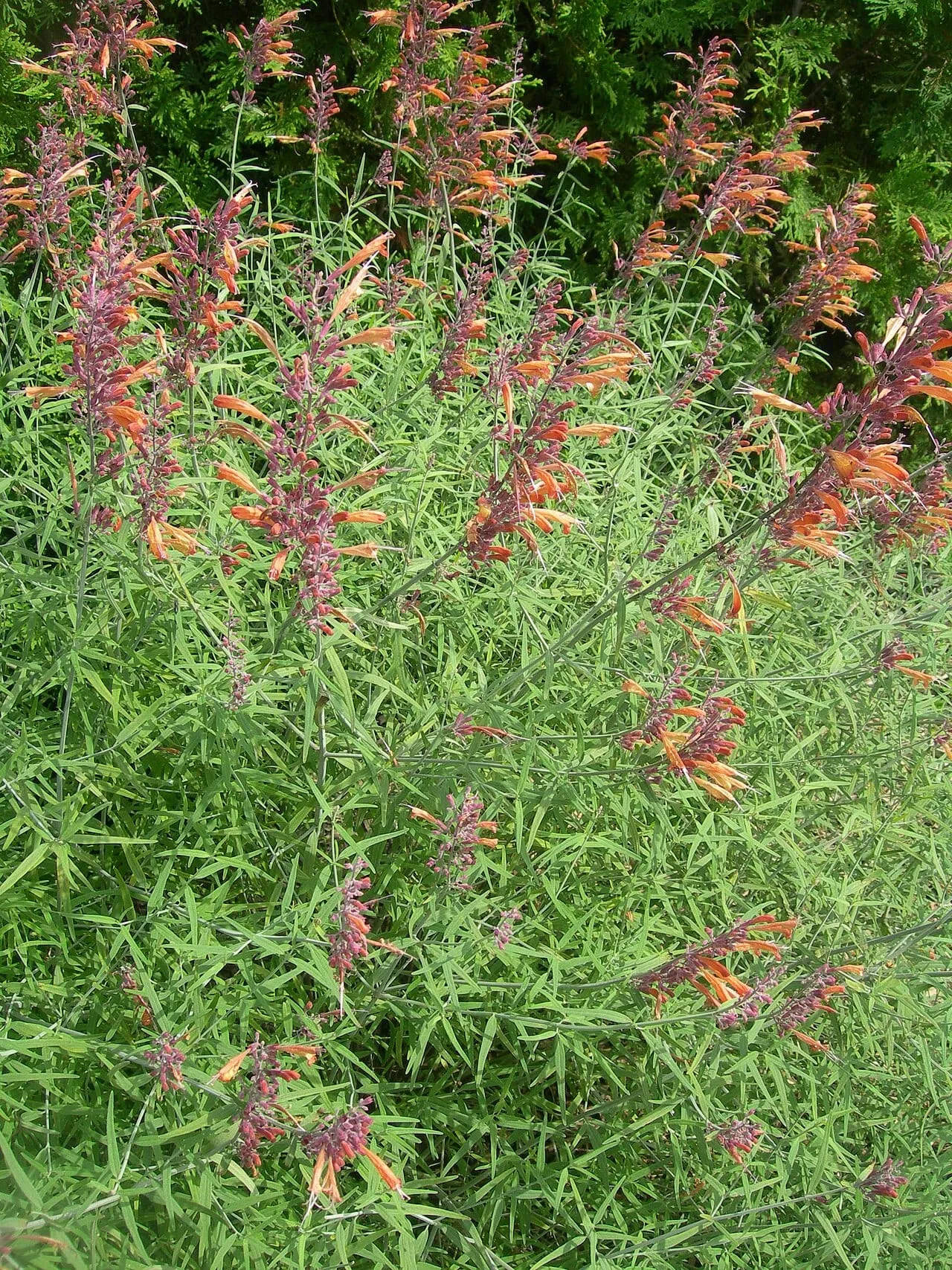
The hummingbird mints. Airier, looser plants in orange, coral, peach, red and pink, with narrow tubular flowers built for hummingbird bills rather than bee tongues. These come mostly from the dry southwest, and they are the group with the least tolerance for wet ground. The Acapulco® series is a widely sold example.
If you want bees and a strong vertical accent, buy blue. If you want hummingbirds and a looser, hotter-coloured planting, buy the mints — and be even stricter about drainage.
Sun and soil
Full sun, six hours or more. Agastache in part shade flops and flowers thinly.
Soil can be loam, sand or shallow rocky ground, at acid to neutral pH. NC State lists it as highly drought tolerant and suitable for dry gardens.
Lean soil is better than rich. Feeding produces soft growth that flops and, in a wet winter, rots faster.
Size and spacing
Allow 3 to 6 feet of space depending on cultivar. That is a wide range — ‘Blue Boa’ is noticeably shorter than ‘Blue Fortune’ — so check the label rather than spacing everything the same.
Wildlife value
This is why most people plant it. Agastache attracts bees, butterflies and hummingbirds, and NC State calls it essential for a pollinator-friendly garden.
It also has excellent resistance to browsing deer and rabbits. Like most aromatic mint-family plants, the foliage is unpalatable, which makes agastache one of the few genuinely showy perennials you can plant where deer patrol.
Bloom
Summer, in upright spikes of tubular two-lipped flowers, across blue, pink, purple, red and white depending on species and cultivar.
Deadheading spent spikes encourages more, though leaving the last flush standing over winter gives seed for birds and a little crown protection.
Propagation
Division, seed, or stem cuttings.
Division is worth doing every few years anyway, since older clumps thin out at the centre. Note that hybrid cultivars will not come true from seed — take cuttings or divide to keep a named plant.
Problems
Beyond winter rot, NC State lists spider mites, thrips, aphids, whitefly and slugs. None is usually serious on a healthy plant in full sun with air moving through it.
The short version
Full sun and sharp drainage, especially in winter — raised beds or pots if your soil is heavy. Choose blue hyssops for bees and structure, hummingbird mints for hummingbirds and hot colour. Do not feed, do not mulch the crown, and expect deer to leave it alone.
- agastache
- hummingbird mint
- drainage
- pollinators
- deer resistant